
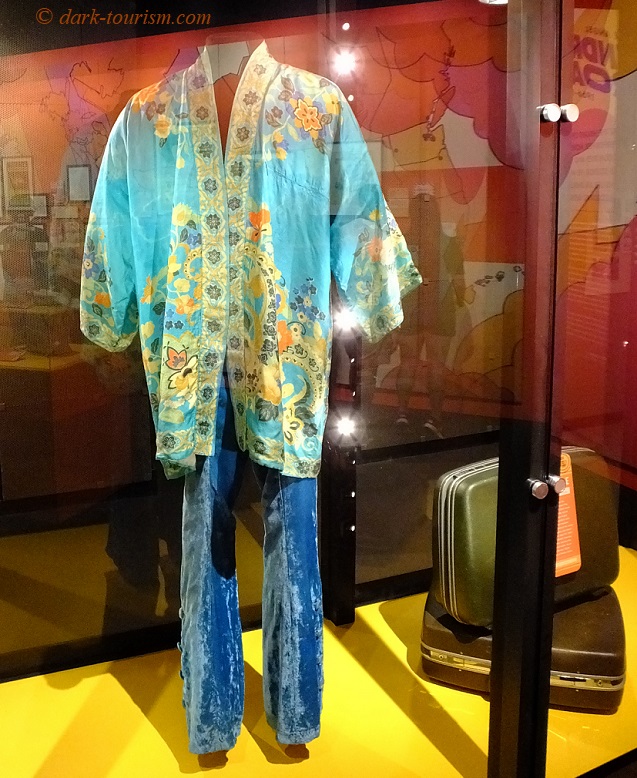
On this day, 51 years ago, Jimi Hendrix died. Arguably one of the most influential virtuosos on the electric guitar, his sudden death came as a great shock to the world of rock music at the time.
On the morning of 18 September 1970 Hendrix was found unconscious in his London hotel room by his girlfriend. She called an ambulance and he was taken to hospital, but all reanimation attempts failed and Hendrix was pronounced dead by midday.
He had been weak, exhausted and possibly ill with flu, and used barbiturates. He had apparently taken a whole handful of sleeping pills and died of asphyxiation, basically drowning in his own vomit.
Given that he was only 27 years of age at the time, his death contributed significantly to the “27 club” legend. Examples of other musicians who died at that age, and are thus “members” of that “club”, include Jim Morrison, Brian Jones, Janis Joplin, Kurt Cobain, Richey Edwards and Amy Winehouse.
The photo above, showing a typical Hendrix stage outfit, was taken in the Museum of Pop Culture (formerly EMP Museum) in Seattle, the city where Jimi Hendrix was born. The museum is generally about pop culture, but with an emphasis on rock music. In the main exhibition, two dead “sons” of the city are given special attention, other than Hendrix that’s Kurt Cobain of the band Nirvana, who were also from the region.
So, given that that’s two members of the “27 club” commemorated in this museum, it definitely is an overlap of mainstream pop culture and dark tourism.
… former followers of my purged ex-Facebook page (or ardent readers of the FB post archive on my main website) may recall some of the text above as one featured there four years ago on this day in 2017.
And those who have followed this blog for eleven months or more may recognize the photo above as having featured here on this blog before as well, namely as the lead image for the themed post “Dark Tourism and Clothes” on 28 October 2020.
… which reminds me, I promised to have another theme post poll, so here we go. This time my four suggestions are these (a couple were runners-up in earlier polls and given another chance here):
A) dark tourism and nuclear power stations
B) dark tourism and reflections
C) dark tourism and furniture
D) dark tourism and hands
Please pick one theme you would most like to see a DT blog post about in the coming weeks by either leaving a comment with your choice below, or if you are a subscriber to the Newsletter you can vote by sending a reply to tomorrow’s newsletter stating your choice.
8 responses
Hi Peter
gotta be reflections for me, stay safe and hope your hand movement improves
Phil
I hope so too … and your vote has been noted.
Reflections. Sounds enigmatic. I synpathise greatly with headaches that make it hard to write problem. Hope it improves.
thanks, your vote’s been noted. The headaches are unpredictable – some days it’s just fine, others are hard and I have to take meds, thankfully that’s not so frequently the case, though.
A bit late to the party this time around, but my vote goes to hands.
noted! thanks!
It’s probably too late for this, but anyways, I vote for hands.
slightly too late, yes, but I’ll take this as a trigger to field hands first – later this week …