I’ve meanwhile returned from my eight-day trip to Naples, Italy, which I also used as a base for excursions to Pompeii and Herculaneum. As before (e.g. for Britain, Bosnia, Portugal and Australia) I’ll provide a brief first overview and photo essay with shots taken by smartphone, while the photos taken with my proper dSLR camera still await processing. But the smartphone images are good enough for this purpose of a quick overview.
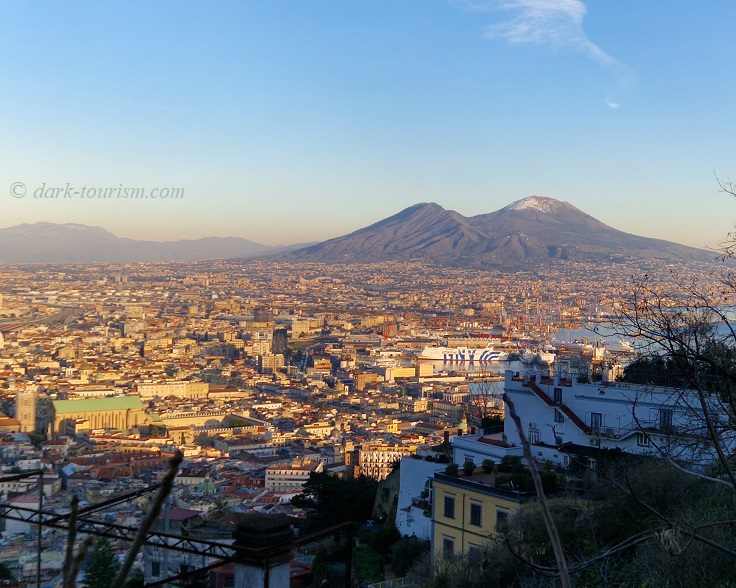
As a first image, here’s a panoramic shot of the city taken from a hilltop terrace next to Castel Sant’ Elmo – with Mount Vesuvius looming large in the background:
.
This was taken on one of the few clear days during my trip. Much of the time the weather was grim and often rainy. One day we even had thunderstorms and hail. On this clear day it was dry but very cold for Naples. As you can see, there was even a snowcap on the main peak of Vesuvius! The adverse weather conditions also meant that I had to abandon my plans of going on an excursion to Vesuvius and climbing up to the crater rim. The ground would have been sodden and/or icy. So I gave up on the idea.
Many of the dark elements I had planned to see in Naples were indoors, or even underground, anyway, so for these the bad weather didn’t matter so much.
Naples was built on a thick layer of tuff, a type of rock consisting of solidified and compressed volcanic ash (from prehistoric eruptions), which is very malleable but still solid (tuff is tough ;-)) and hence useful as a building material. From antiquity, the underground of Naples was therefore also mined for such tuff building material. The underground was also used for water cisterns filled by underground aqueducts that collected water from many miles away (as Naples lacks a river). Moreover, there are several underground catacombs that also made use of the properties of tuff. So the Naples underground is like a Swiss cheese, some say. During WWII these underground caverns and now defunct subterranean aqueducts came in handy as air-raid shelters for the population – as Naples became southern Italy’s most bombed city (a target for the Allies given its strategic port, especially after the landings on and the occupation of Sicily by the Allied forces in 1943). After the war, the rubble from the destroyed buildings was simply dumped into the underground caverns. But after decades of these places being largely forgotten, some parts were cleared of the rubble and eventually made accessible to visitors.
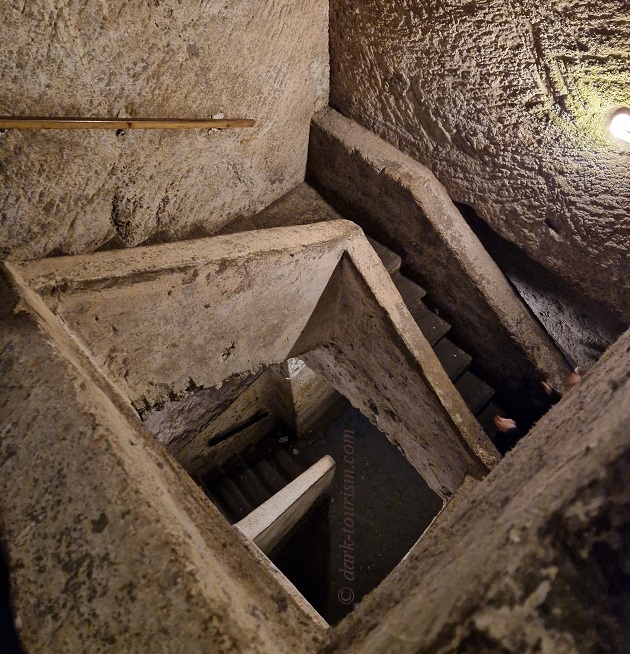
The association that runs “Napoli Sotterranea” (‘Underground Naples’) has two separate sections that can be visited on guided tours. The first one I had pre-booked was the one underneath the so-called Spanish Quarters (Quartieri Spagnoli). The tour starts with a descent down hundreds of steps of this staircase into the underground:
.
.
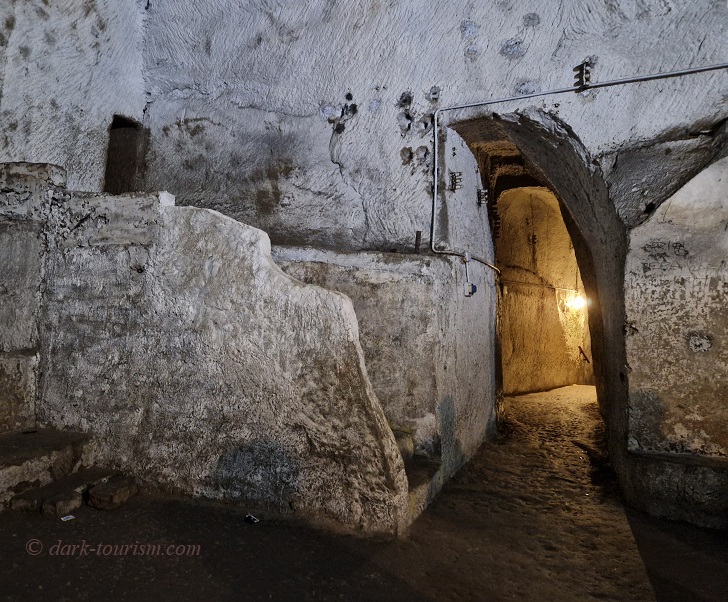
At the bottom we were led through a maze of underground passages and caverns, such as you see in the next photo:
.
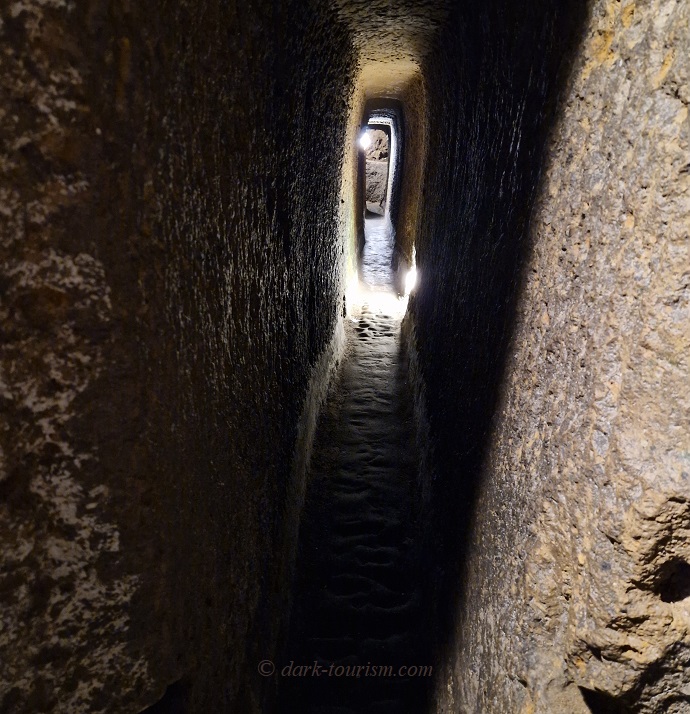
Some parts are really cavernous, almost like underground cathedrals, and the guide pointed out to what level these used to be filled with water. In the past virtually all houses at the surface had access to drinking water from such underground cisterns, with water collected by buckets or amphorae on long ropes. There are also some very narrow passageways, where water would have flown fast under pressure. One section of such narrow tunnels was also part of the tour (with an alternative route for those too claustrophobic for this “adventure”):
.
In some of the caverns there were also relics from the time when the underground served as an air-raid shelter. The guide also related various legends and stories from the history of Napoli’s underground.
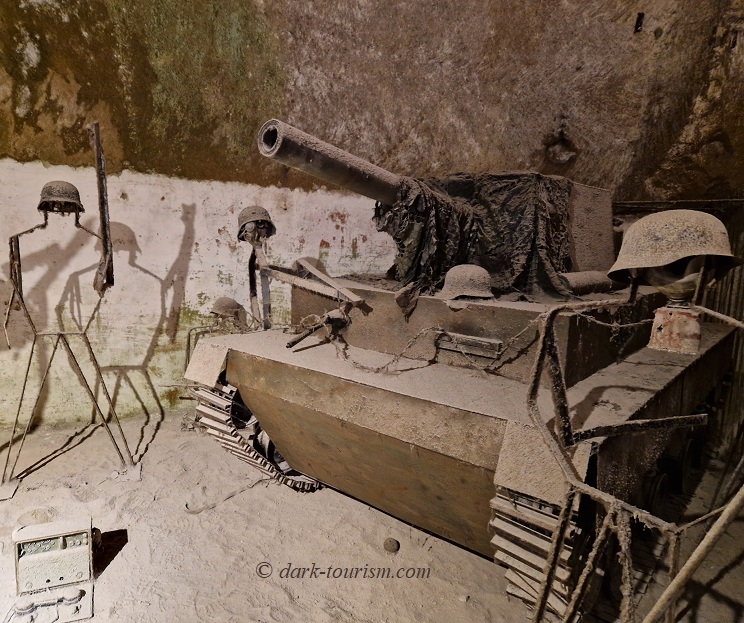
The other section of Napoli Sotterranea is underneath the Centro Storico (historic centre) right in the most touristy part of the city just off Via dei Tribunali. Hence it’s also much more popular, and the group I managed to tag on to was significantly larger than the group at the Quartieri Spagnoli had been. That detracted a bit from the experience, but on the other hand this section also had some added value that the other one lacked. Otherwise the tour was similar, and also included a section of extremely narrow tunnels (you had to squeeze through sideways – quite a few participants opted out of this). Early on in the tour there was a point with this crude WWII-related installation:
.
Another feature of this section of the underground is that you get to see a couple of preserved or reconstructed (and refilled) water cisterns, which really looked quite atmospheric – note also the amphora suspended on a rope above the water:
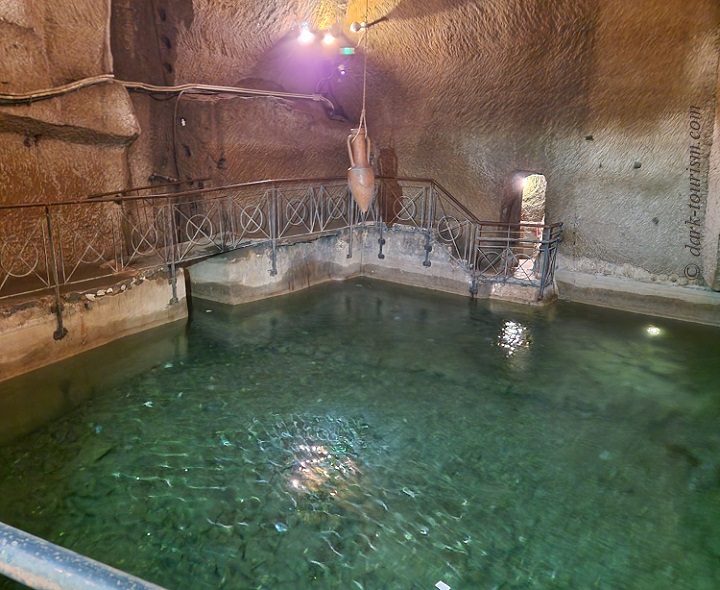
.
Back at street level, there’s also a small, single-room “War Museum”, which has a few glass display cabinets filled with WWII relics, including this collection of Nazi memorabilia:
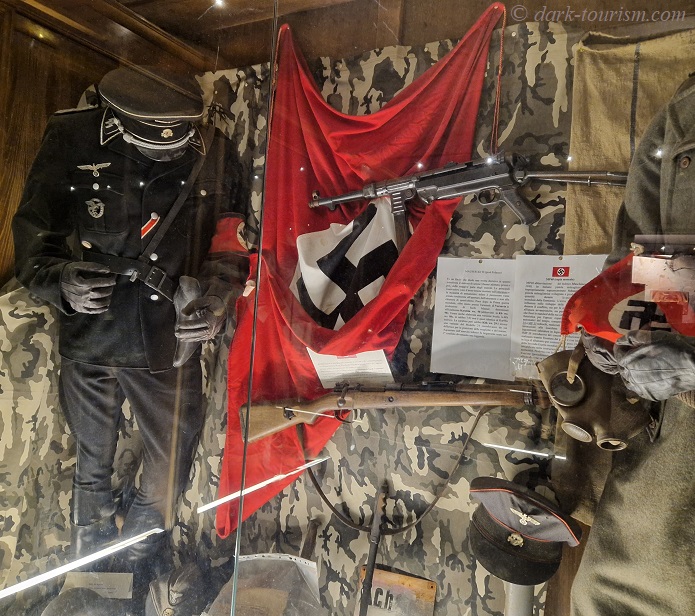
.
Another such underground attraction is the so-called “Bourbon Tunnels”, or ‘Galleria Borbonica’ in Italian. This is actually a combination of yet more underground passageways and former cisterns, also used as air-raid shelters during WWII, with a straight tunnel especially dug for then Bourbon King Ferdinand II as a possible escape route, connecting the Royal Palace with a military barracks, as he was fearful of potential popular uprisings against the monarchy. Yet the king died before the tunnels were completed and construction was halted, so they are incomplete and also not quite as wide as had originally been planned. The tour today starts in the former aqueduct parts and includes a good number of relics from WWII, including graffiti from that time. The tour route also went past some still (or again) water-filled cisterns:
.
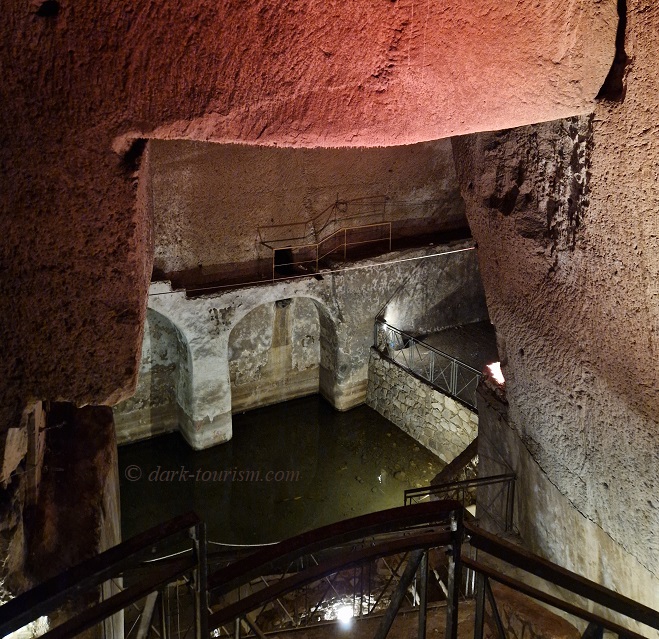
.
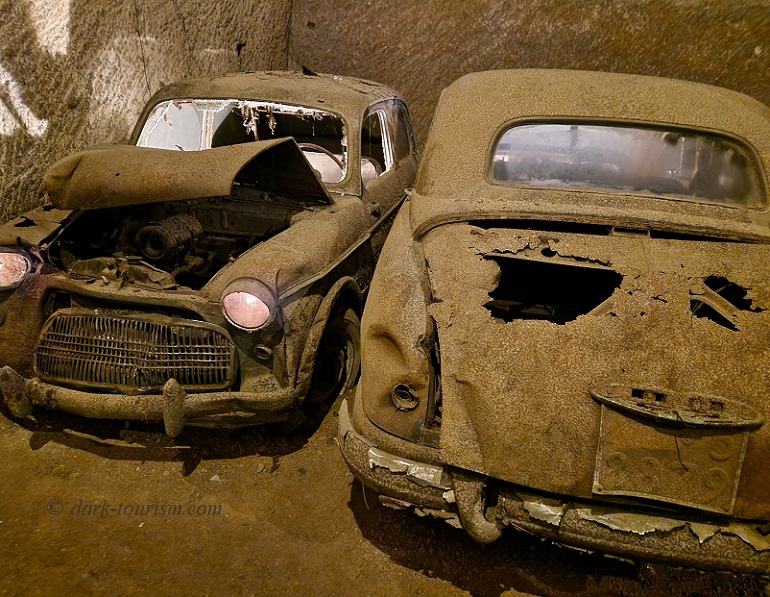
The highlight of this tour was the section where old cars, motorbikes and bicycles had been dumped in the 1950s/60s:
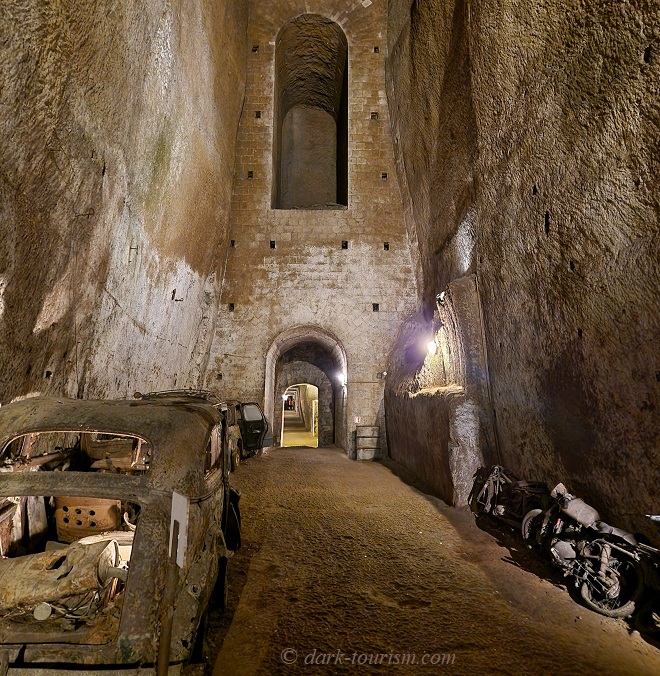
.
To add more atmospheric touches, some of the car wrecks were even lit up from inside, so it looked like their headlights were still working:
.
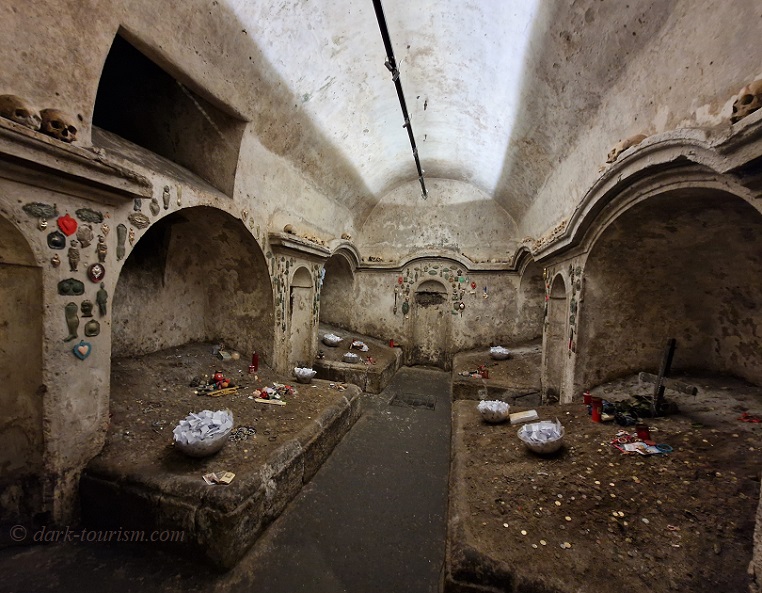
Yet more underground attractions I visited, though not that deep down, include some church crypts, such as this one under the small Chiesa di Santa Luciella ai Librai:
.
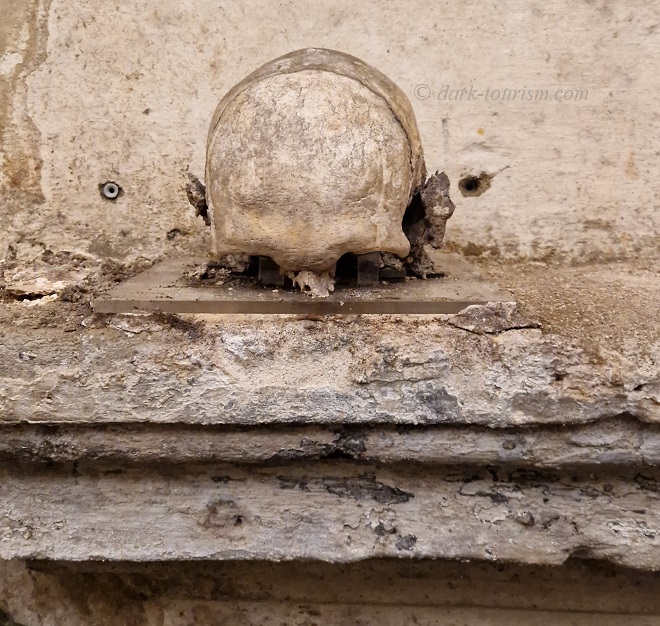
The church is not in use as such (and had in fact been refurbished by a private initiative after decades of neglect), but now just a visitor sight … and the star attraction of the crypt is the so-called “skull with ears”:
.
You can imagine that some myths have evolved around this skull, e.g. the superstition that it could “hear” your prayers. But of course these are not really ears but some abnormal bone structure.
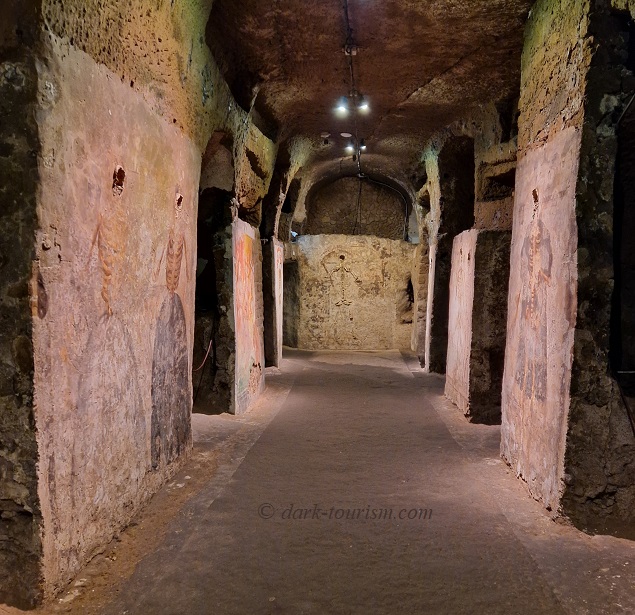
More grimness can be found in the Catacombe di San Gaudioso, which date back to the earliest centuries of Christianity:
.
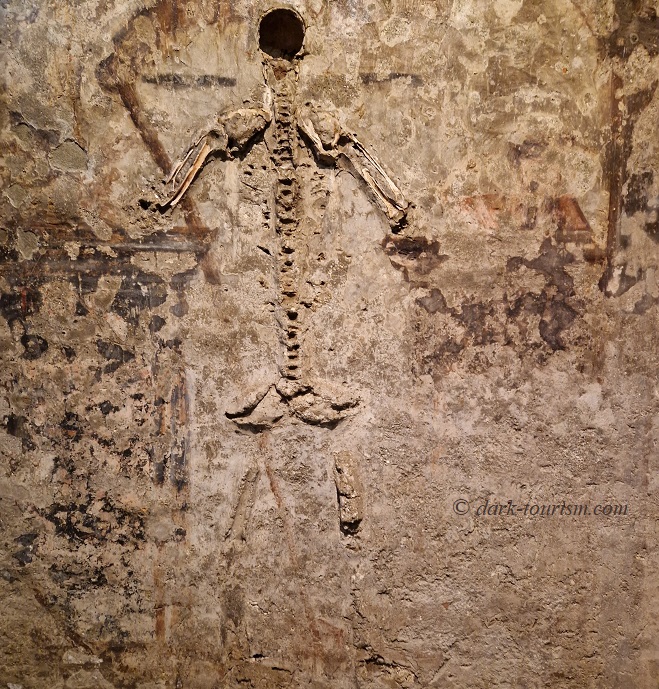
At the one end of this chamber a real skeleton has been worked into the wall, and the guide explained that it was supposed to be the “gatekeeper” of the crypt:
.
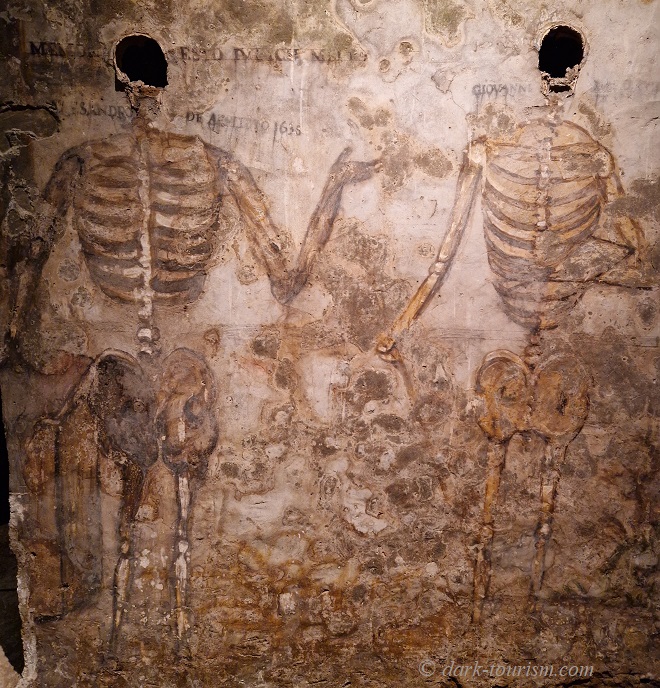
The rest of the walls of the main part of the catacombs features various murals of skeletons with real skulls set into the wall instead of heads – or rather only half skulls, namely the back, while the front of the skulls had been hacked off:
.
Strictly speaking, being so ancient, these catacombs should fall outside the time frame I apply for dark tourism on my main website (namely only from the late 19th century onwards), but because of the spookiness of the skulls and bones I included them here anyway.
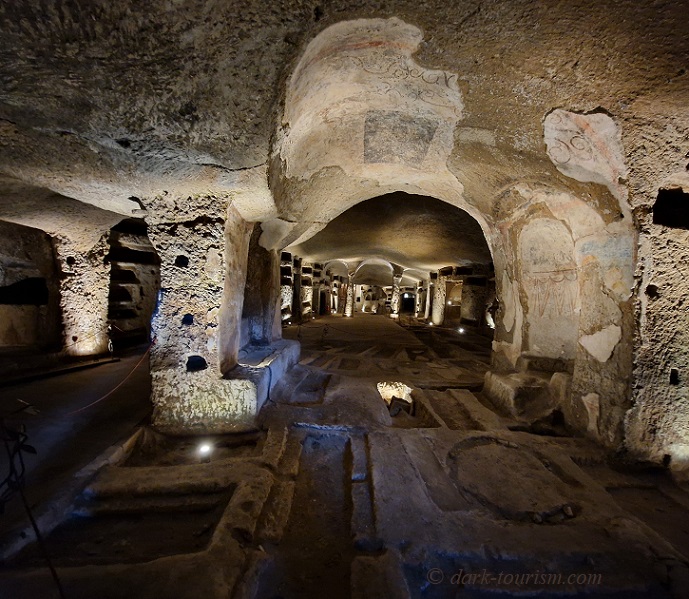
Another set of catacombs, similarly ancient but much, much larger are the famous Catacombe di San Gennaro. Here’s an impression:
.
Another crypt with lots of skulls that I wanted to see would have been at the Cimitero delle Fontanelle, but unfortunately this was closed (and apparently has been closed for years, according to my guide). Yet another place I did visit, though, was the Cappella Sansevero, which is most famous for its fabled marble sculpture of a veiled corpse of Christ (a masterpiece in the so-called trompe-l’œil style of optical illusion; in this case the illusion that the veil is transparent). But in the chapel’s crypt two darker exhibits await visitors, the so-called “anatomical machines”, actually medical wax models of two humans without skin and with their vascular system exposed. Pretty creepy to look at. Unfortunately, photography was strictly forbidden at the Cappella Sansevero, including in the crypt.
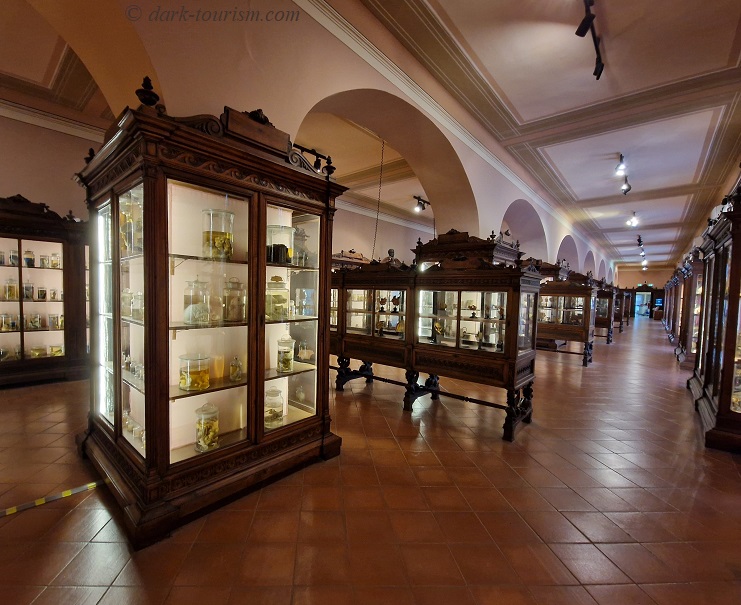
Much more in that medically grim vein can be found at the fabulous anatomical museum at the medical university – and here there were no restrictions regarding photography (which is rather unusual at a medical exhibition; normally these are quite strict on the no-photography front):
.
The number and nature of the specimens on display in the many ornate cabinets is stunning and beats almost any other medical museum I’ve ever encountered. Here I can only give you a small sample, for instance this collection of tiny skeletons showing various deformities:
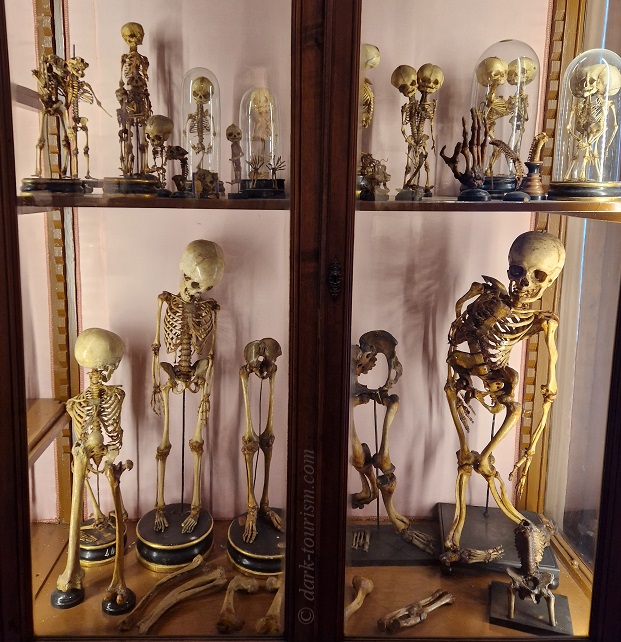
.
There are also much more gruesome specimens in formaldehyde jars, especially babies, from anencephalic ones to ones with cyclopia to various severely deformed conjoined twins. Adult ailments on display can also be stomach-turning, as are some of the few animal specimens (e.g. a double-headed goat). I’ll spare you images of all those and just give you one that is not of a real specimen but a wax model … still not so pleasant to behold:
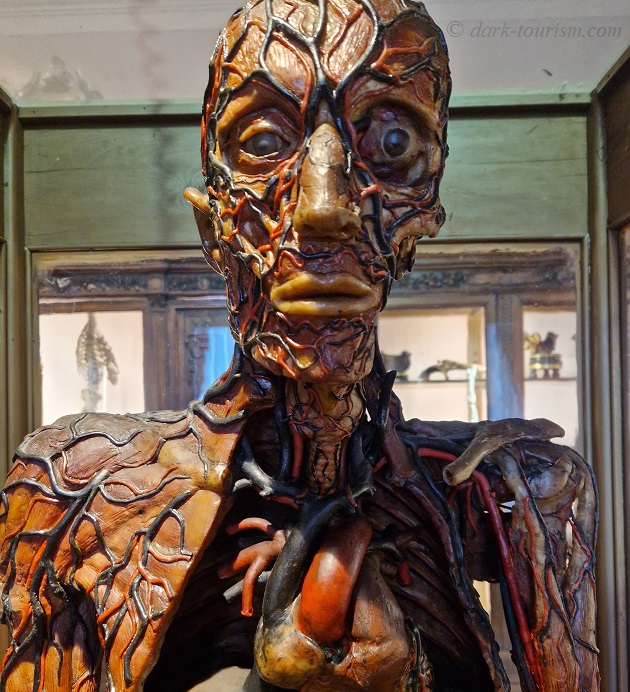
.
Of course I didn’t spend all my time in Naples indoors or even underground but also did a lot of walking outside whenever the weather allowed. One day when it was dry and the cloud layer almost broke I made it all the way out Bagnoli on the western edge of Naples. When I researched the science museum there I found out that this is located right next to the former gigantic steelworks complex of the same name, Bagnoli. On Google Maps I saw that while much of the complex, which closed sometime in the 1990s, has been demolished, some rather big structures still remain. So I was keen to get out there to try and do some urbexing. The first large ruin I encountered was this:
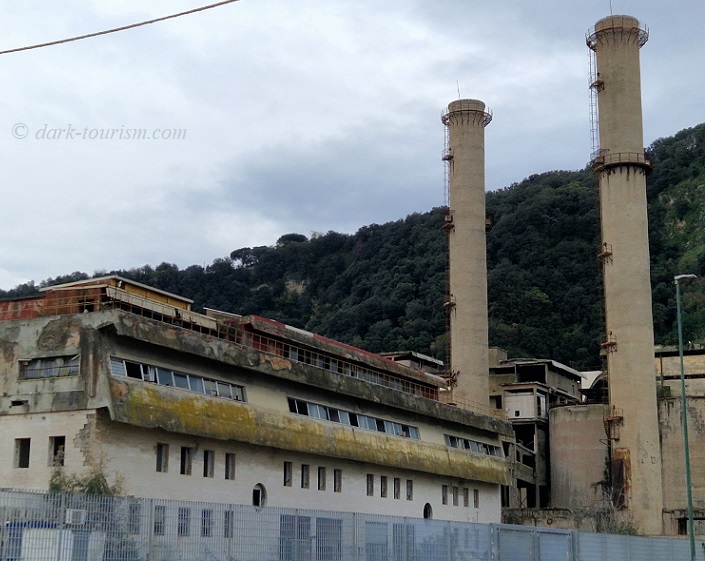
.
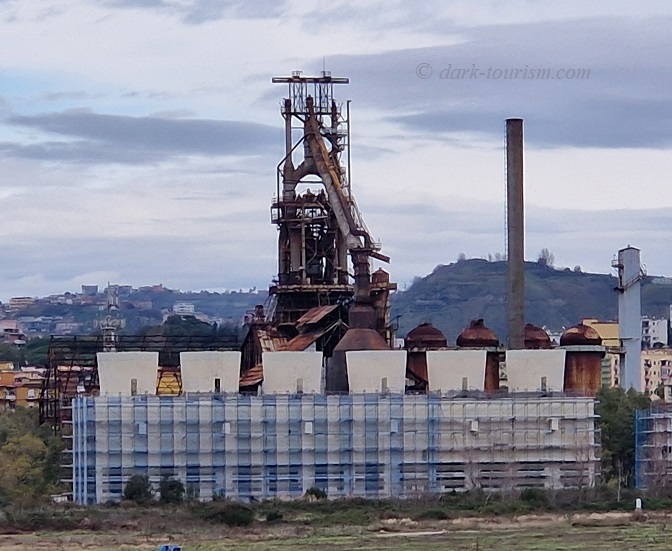
I would have loved to go in and explore closer up or even inside, but there was a high wall/fence all around the perimeter with only one gap with a gate that was open. From there I got a quick shot of the most intriguing of the remaining structures here, the gigantic blast furnace:
.
I only got this distance shot, as I was prevented from proceeding any further by security, who quickly shooed me away. Shame. Seeing a blast furnace up close is one of my so far unfulfilled dreams. Oh well.
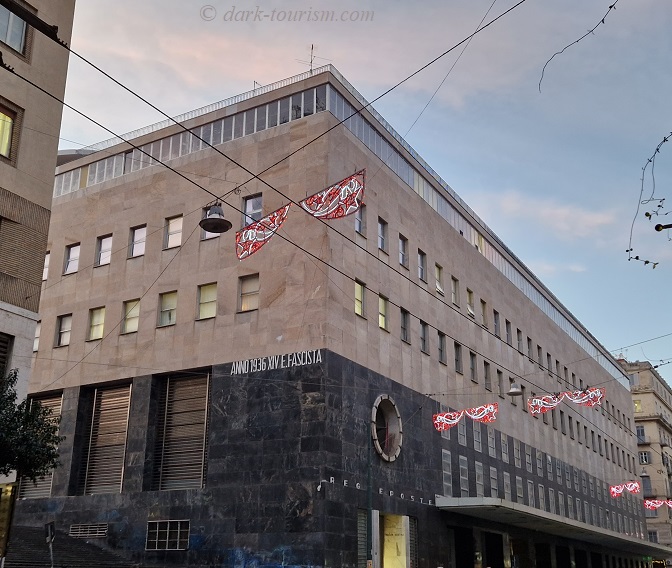
On my wanders in or close to the city centre I also came across the odd dark detail, such as this post office building, clearly marked as dating back to the Fascist era, to 1936:
.
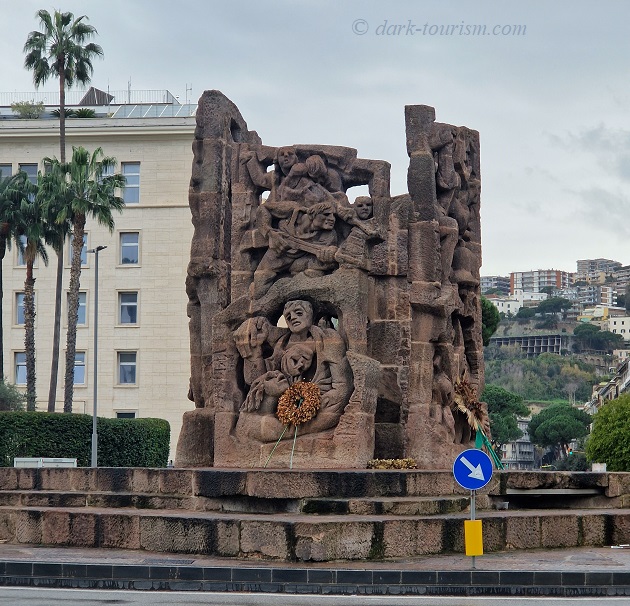
I also spotted monuments from that era, including ones commemorating WW1, but also this intriguing structure:
.
We didn’t know what it stands for and I didn’t find any signs explaining it, but my wife and I both thought it was in the style of a Holocaust memorial monument. But I later researched it and found that it is instead dedicated to the “Scugnizzo”. That’s the word for the young men who fell during the “Four Days of Naples” in late September 1943 when the Neapolitans successfully rose up against the Nazis, so that when the Allied forces arrived in Naples shortly after, they found that the job of kicking the Nazis and Fascists out had already been done by the people themselves. It’s something that the Neapolitans are still very proud of.
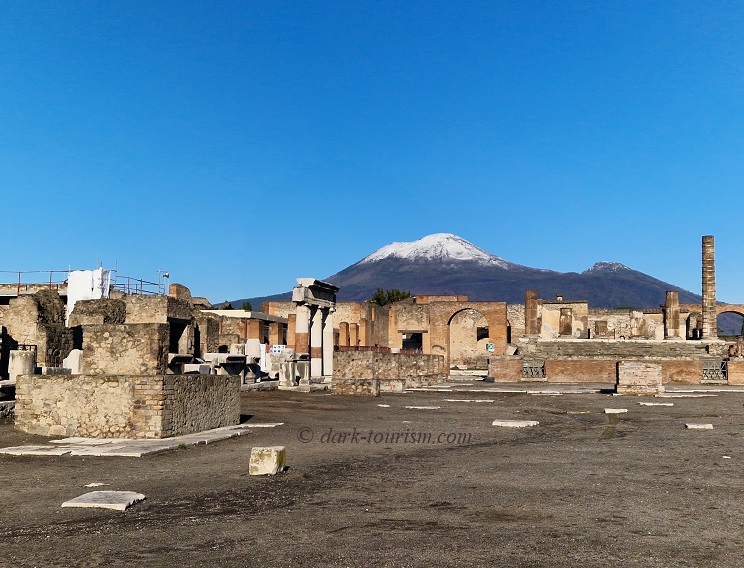
I didn’t spend the entire eight days of this trip in Naples itself, but also used it as a base from which to go on day trips to Pompeii and Herculaneum. But that’s something for a separate Blog post of its own soon. Here I will leave it at just one photo each from those two sites. First, here’s one from Pompeii:
.
As you can see it wasn’t busy, so I managed to get several shots in without any other people in the frame. I had made sure to arrive really early, just after the site opened, and the ca. 40 or so people who had queued quickly dispersed in the vast area that Pompeii occupies. Later in the day, it did fill up much more though. So it had been a good idea to start so early.
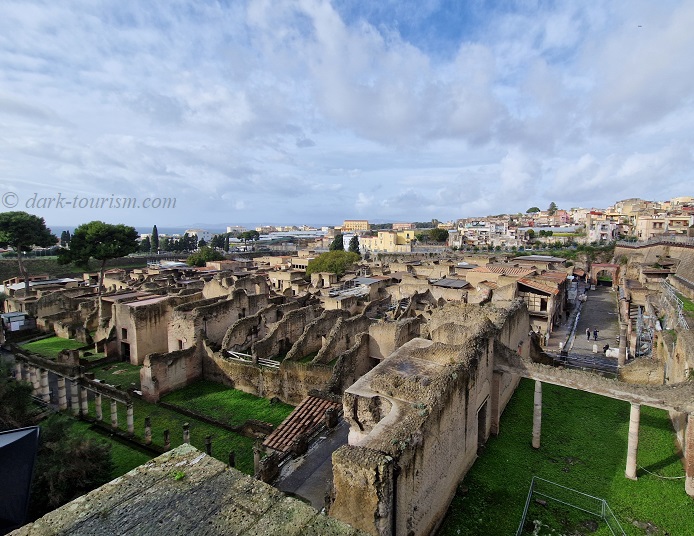
For Herculaneum we left it to ca. midday, but that too wasn’t overrun, as it’s far less world-famous than Pompeii. This more recently excavated part of an ancient Roman city was also a victim of the eruption of nearby Vesuvius that destroyed Pompeii in CE/AD 79. But while Pompeii was covered by layers of volcanic ash fall, allowing large parts of the populace to flee before the city was completely buried, Herculaneum fell victim to pyroclastic flows, fast super-heated surges of gas and ash that very quickly engulfed the city. In Herculaneum skeletal remains of victims were later found in some boat shelters where they had apparently tried to take refuge – these remains are still on display at the site where they were found. (Although today they are copies of the genuine things.)
But here’s a panoramic shot of Herculaneum taken from the approach path. It gives you an impression that this site is far less sprawling than Pompeii:
.
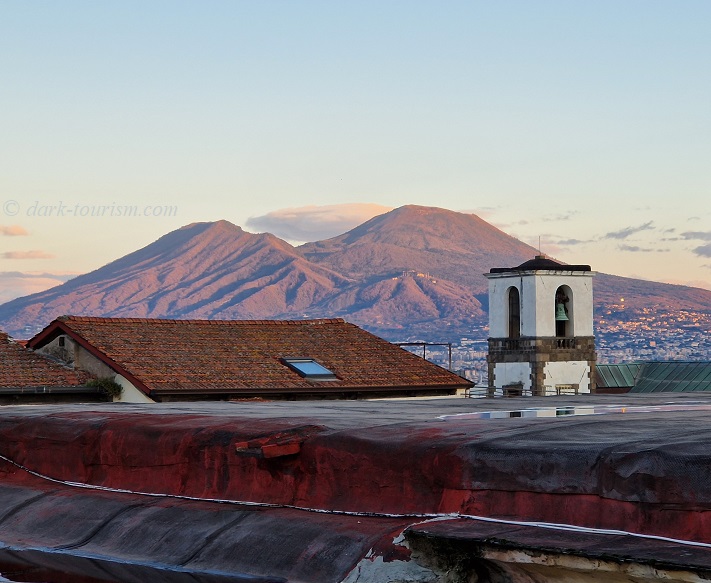
But as the final photo for this post I give you one showing the “perpetrator” of that deadly disaster in antiquity, Mount Vesuvius, the still active volcano that continues to threaten its surroundings, including Naples. I took this photo from the bedroom window of the rooftop apartment I had rented for the duration of my stay, showing Vesuvius in all its glory in the “golden hour” just before sunset (same image as the featured photo at the top of this post):
.
But with this I shall come to a close. I hope you’ve enjoyed this new photo essay. Next time we’ll look at Pompeii and Herculaneum in more detail.