This post features something in my adopted home city of Vienna. Recently I paid a visit to the “Rapideum”. That’s the name of the museum of the football club Rapid Vienna (official full name: Sportklub Rapid, hence the abbreviation SKR), originally a working-class club of western Vienna (Hütteldorf). I had read about this museum in a book about hidden gems in Vienna and when I learned that the museum doesn’t shy away from the darker aspects of the club’s history, I was keen to go. I wasn’t disappointed. Read on …
Of course, much of the museum (located right behind the massive fan shop underneath the club’s stadium) concentrates on the glory days and victories, of which the club had many. It still holds the record for winning the Austrian national league the most times plus various other cups, including some international ones. At the Rapideum, this is accordingly the holy of holies of the museum, the trophy room (“shrine” more like):
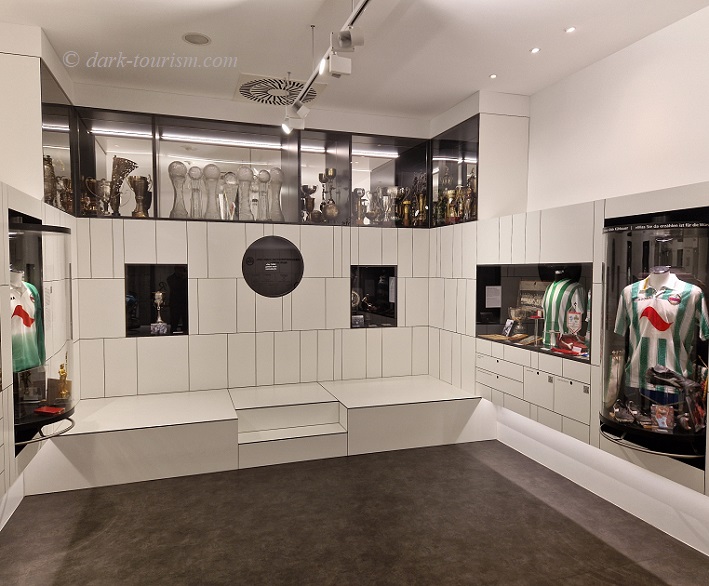
.
But, as indicated, the museum also covers the not so glorious aspects of the club’s history. The main dark theme in the Rapideum is the time of the Nazi era when Austria was annexed by Hitler (himself an Austrian) in the so-called “Anschluss” of March 1938.
Later that same year Rapid Vienna won the “Tschammerpokal” the German national cup tournament trophy that had first been introduced in 1935. Here’s the display cabinet about that:
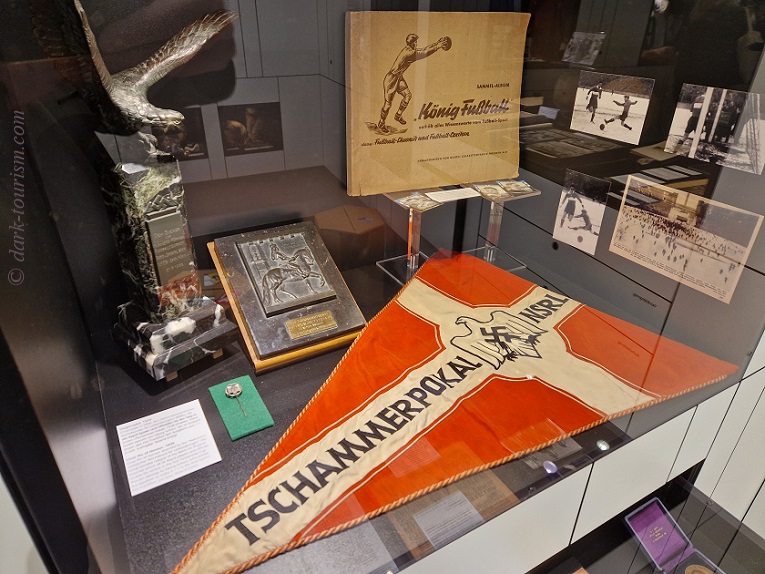
.
In 1941, Rapid Vienna also won the German premier league, then called “Kriegsmeisterschaft” (‘war championship’), against the long-established traditional, also working-class (in the Ruhr area of western Germany) club Schalke 04. This is the trophy ball for that achievement (same photo as the featured one at the top of this post):
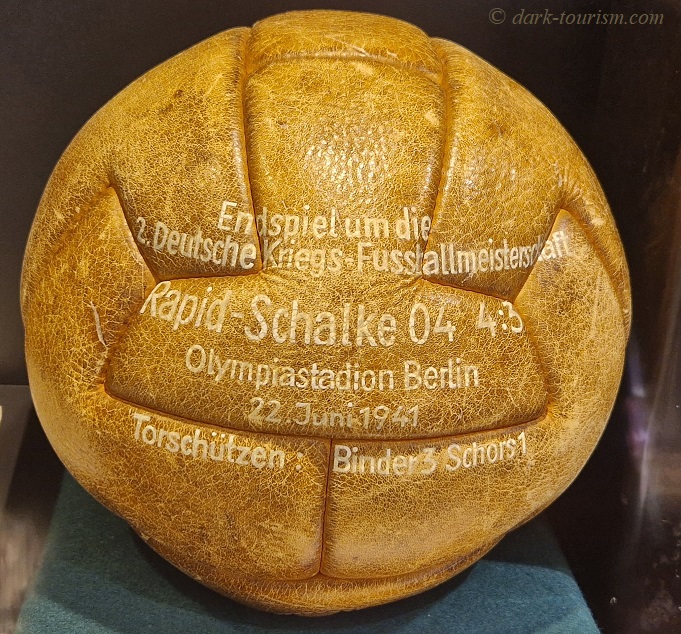
Also on display is a golden pin – with a swastika in the centre – that was given to all of Rapid Vienna’s team members after the match. The one on display is the pin that was given to one of the goal scorers (Schors):
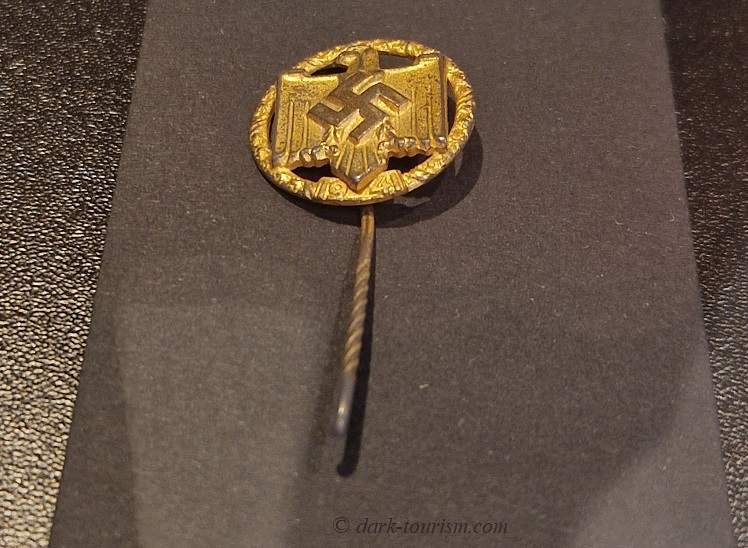
.
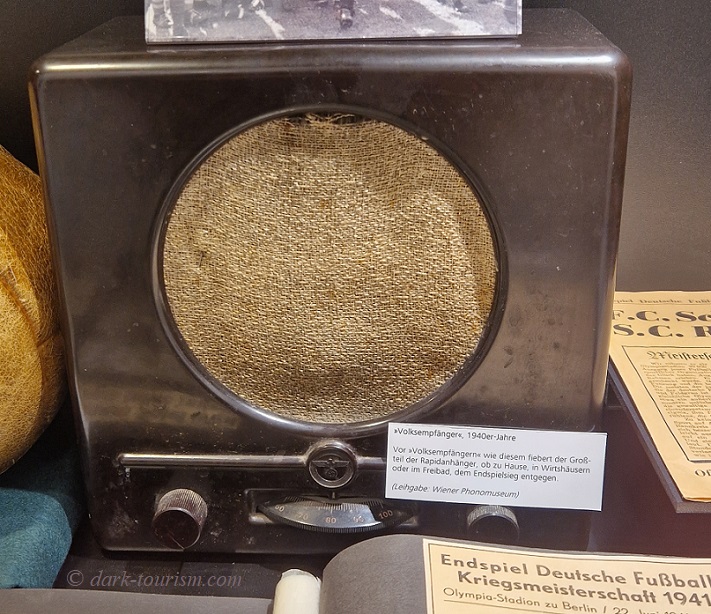
Since the final was played in Berlin at the Olympic Stadium most Rapid fans would have followed the match on the radio, in particular on the mass-produced wireless sets called “Volksempfänger” (whose principal role was dissemination of Nazi propaganda, of course). Here’s a specimen of those radios:
.
But the texts and documents in the museum make it clear that Rapid Vienna was also affected by the Nazi regime of terror. Players were banned for racial or political reasons, some were drafted into the military (and some of those were wounded or fell in battle), and the club’s officials tried to walk the thin line between adapting to the new times, collaboration and maintaining an independent club spirit. Yet there were also perpetrators in the club.
In this context you also have to remember that at that time Austria was a force to be reckoned with in international football – and there were quite a few football stars here that were Jewish … but then came the Nazis and the Holocaust. Vienna even had an all-Jewish sports club called “Hakoah”, whose football team once managed to beat West Ham United five-nil (in 1923). Obviously the club was one of the first targets when the Nazis annexed Austria and they instantly disbanded that club. While several athletes managed to flee abroad, others got caught up in the Holocaust and were murdered. On the other hand, some non-Jewish players, especially the legendary Franz “Bimbo” Binder, became superstars in the Third Reich and played for the “Greater Germany” team internationally.
Post-war Austria was notoriously slow in confronting its Nazi past, much less willing to follow Germany’s “Vergangenheitsbewältigung” (‘coming to terms with one’s past’), instead preferring to portray Austria and the Austrians as “the first victims” of Nazism (disregarding how enthusiastically large parts of the population welcomed the Nazis and the Anschluss). This only began to change decades later.
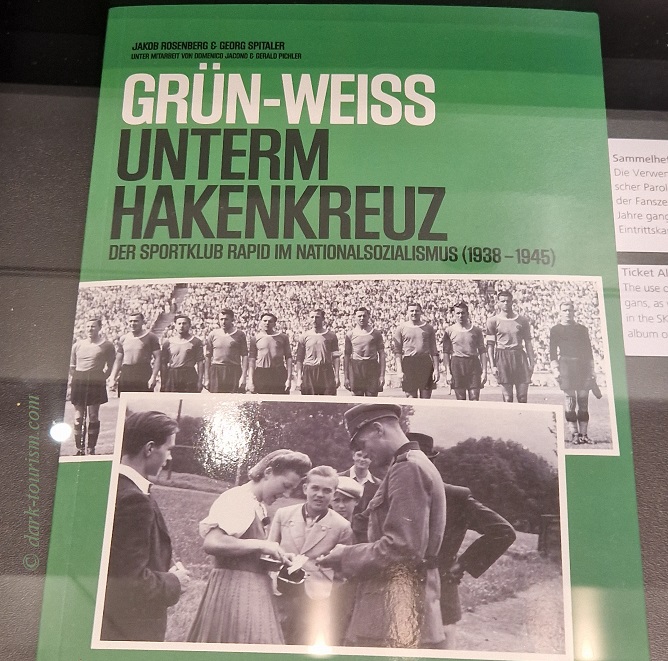
Long after the Nazi era and WWII a book was published about Rapid during that time – the title of which translates as “green and white under the swastika” (those are the club’s main colours), a copy of which is on display at the Rapideum:
.
.
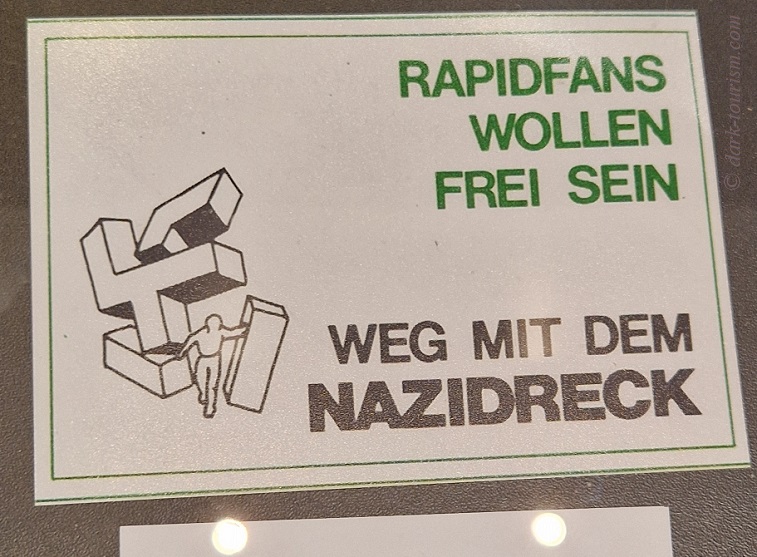
In the 1980s, neo-Nazis started infiltrating Rapid’s fan base. And some supporters put up a defiant campaign against this development. On display in the Rapideum is this item:
.
The words accompanying the shattered swastika symbol mean “Rapid fans want to be free” and “Away with the Nazi muck”.
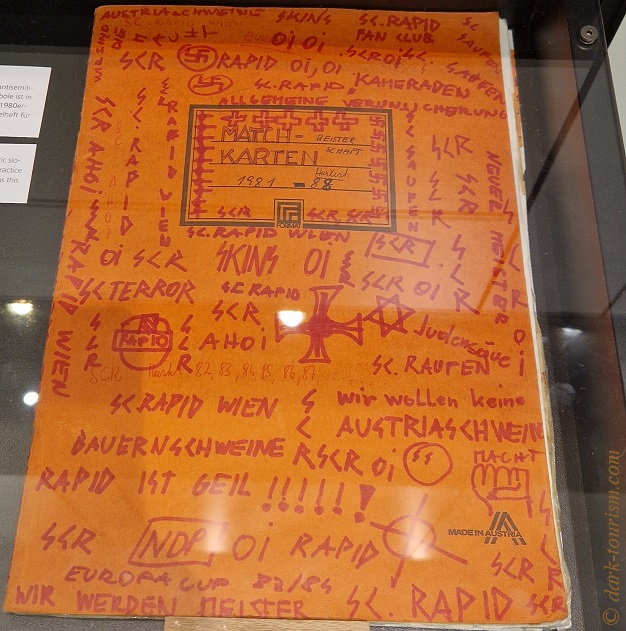
Yet there is also evidence on display as to how deeply neo-Nazism managed to sink its fangs into the club’s fan base, as you can see in several hand-written symbols “adorning” this fan’s match journal:
.
Amongst Swastikas, iron crosses and the Germanic rune for the letter <s> (as in the Nazis’ SS) is also an openly anti-Semitic reference: “Judensäue” (‘Jewish swine’) next to a Star of David. And at the bottom is a reference to the then main German neo-Nazi party NPD (now replaced, and absorbed, by the AfD, of course).
The club’s fans are a major focus in the Rapideum, including those who call themselves “ultras”. Here’s a photo of a display cabinet with “ultra” fan items:
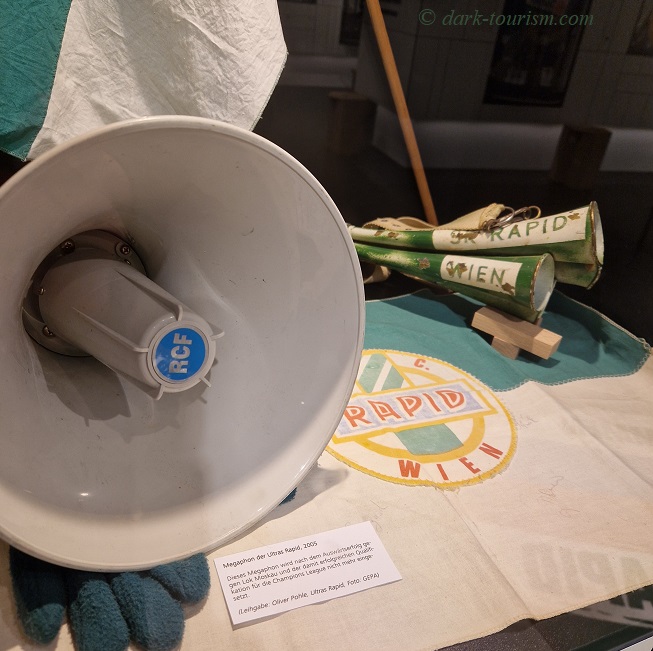
.
One problematic aspect of “ultra” fan culture is the use of pyrotechnics, and Rapid Vienna is no exception, far from it. Here’s a Rapideum display related to this aspect:
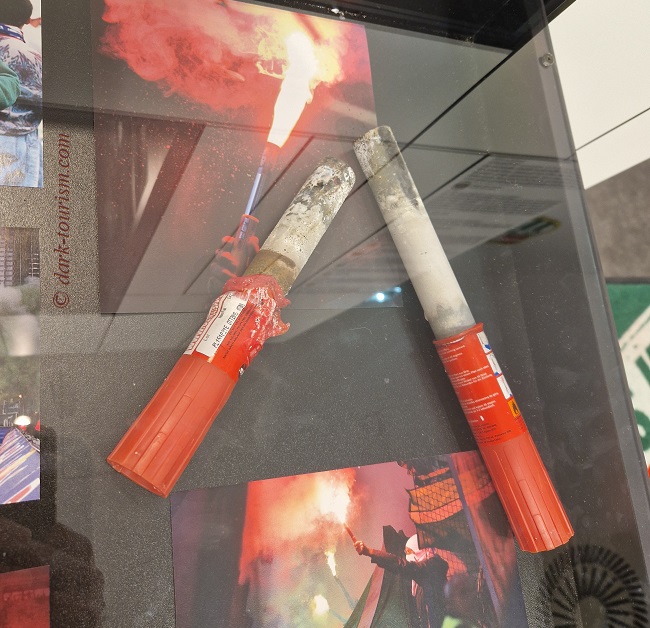
.
Also on display are a few documents from court cases in which fans were sentenced to pay fines or, if they couldn’t pay, even go to prison, for such illegal use of pyrotechnics.
And there is worse. One section of fans even refer to themselves as “Terrorszene”, and one display cabinet covers the case of a Rapid fan killing another club’s fan:
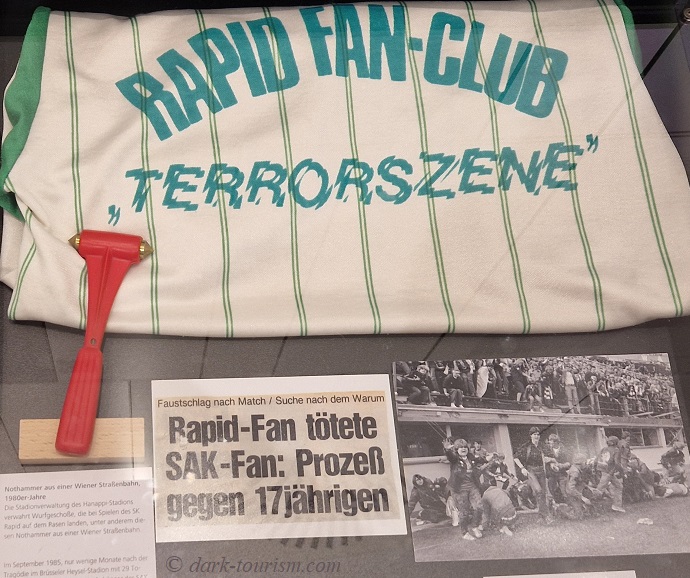
.
One other dark element covered in this display is a disaster in which Rapid was involved, namely when in 1982 part of the Prater Stadium collapsed leaving numerous Rapid fans tumbling down, with several badly injured (not quite Hillsborough – see Liverpool – but still). This happened as the club was about to be handed the trophy for winning the Austrian league once again and before a friendly match against Red Star Belgrade was to commence. The red hammer you can also see in this photo was used as a missile thrown on to the pitch by a fan who must have stolen it from a tram (its intended function is to break the tram’s windows in an emergency).
Not as dark, but still with a darkish aspect to it, is the display in one cabinet of a pack of cigarettes the legendary player and then successful coach Ernst Happel used to smoke. In fact he smoked himself to death: he died of lung cancer aged 66 in 1992. The ashtray was a gift Happel received during his time as head coach for the Dutch team Feyenoord Rotterdam after winning an international cup in 1970.
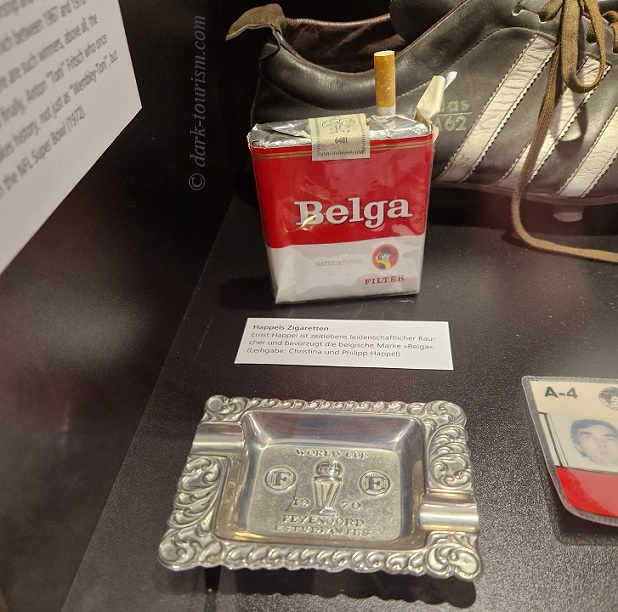
.
The largest stadium in Austria, formerly known as Praterstadion, was renamed after Ernst Happel following his death.
Happel, who started his active career with Rapid Vienna, won the Austrian championship six times and was part of the Austrian national team that managed to end in third place in the 1954 World Cup, is one of the players that the club voted into the symbolic “Team of the Century”. Several other players who were honoured in the same way have their own display cabinets at the Rapideum, including Hans Krankl, one of the most prolific goal scorers of all time (his winning goal against reigning champions Germany at the Wold Cup in 1978 made him a national hero).
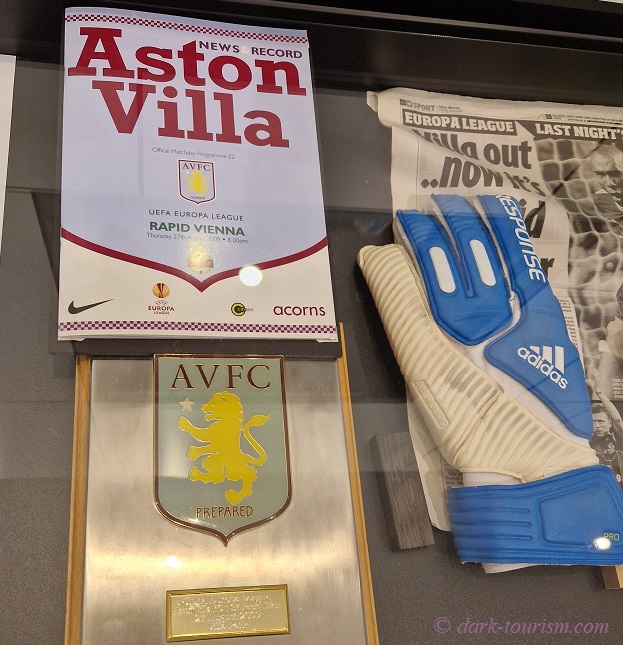
Of course, the glory aspects of the Rapid Vienna club are a main focus at the Rapideum and they are duly celebrated, as are seminal victories in international matches. But there are always two sides to a victory – there’s always also a loser. One of the most recent successes against big-name international clubs was in August 2009, when Rapid managed to kick the English club Aston Villa out of the Europa League … I know several people in Birmingham who are Villa fans and would not have been happy bunnies on that occasion …
.
But with that I shall bring this “DT and Football” Blog post to a close. I hope you enjoyed reading it and appreciate its rather unusual theme.