
At the end of the previous Blog post about the Ukraine war and how it has affected dark tourism (DT) I promised that I would find a less depressing topic for the next, this Blog post. And so I decided to revive the tradition of the themed post (the latest few were this, this and this) and picked the theme of DT & Toilets. That will have its lighter, even amusing aspects, though of course it’s still about dark tourism, and so must have its serious sides too. I’ll save the funnier ones for the end part of this post – so keep reading to the end!
Where to begin? Where can dark tourism and toilets overlap? Well, one thing you may think of when confronted with the juxtaposition of dark tourism and toilets could be those large latrines at concentration camps, such as in the first photo, taken at Auschwitz-Birkenau:
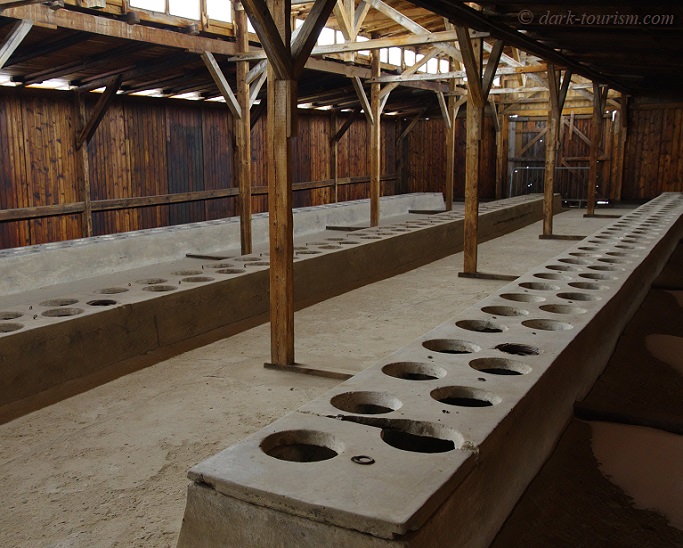
.
Other toilets in dark places include those inside prisons. Here’s an example from the infamous prison at Constitution Hill in Johannesburg, South Africa:
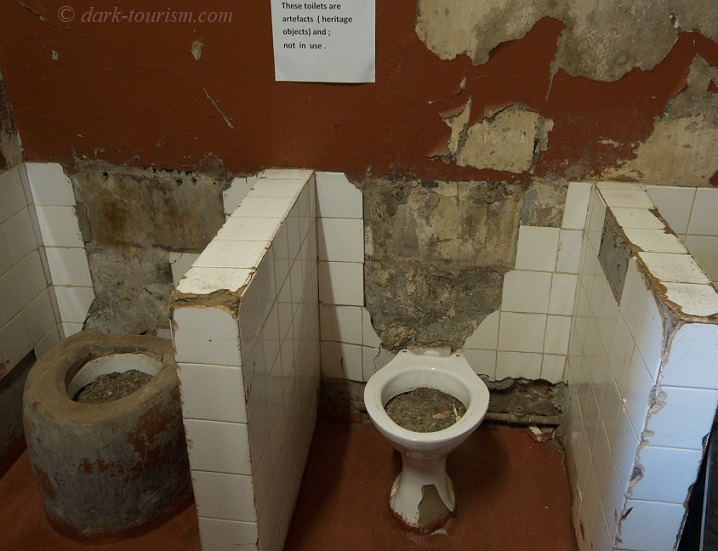
.
Note the little sign saying these toilets are “artefacts (heritage objects) and not in use” … as if anyone could really be tempted to use them – the bowls are filled with sand and there are no cisterns! The prison at Constitution Hill was both for regular criminals and for political prisoners during the Apartheid era. Nelson Mandela was imprisoned here for a while, but he wouldn’t have used these loos as he had quite a privileged single cell then.
Also from a prison for political prisoners, but this time in Taiwan during the Chiang Kai-shek dictatorship, is the following photo:
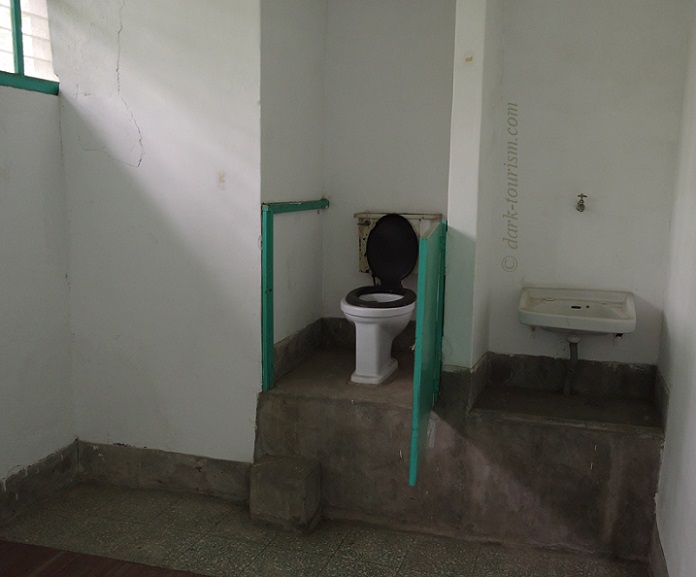
.
This was taken at a group cell that features a rather elevated toilet you had to climb up to. It’s at what is now the Jing-Mei White Terror Memorial in Taipei.
Yet another political prison that’s been turned into a museum about political repression and incarceration not so long ago is to be found at Peniche Fort in Portugal, where you can see these rather clean urinals:
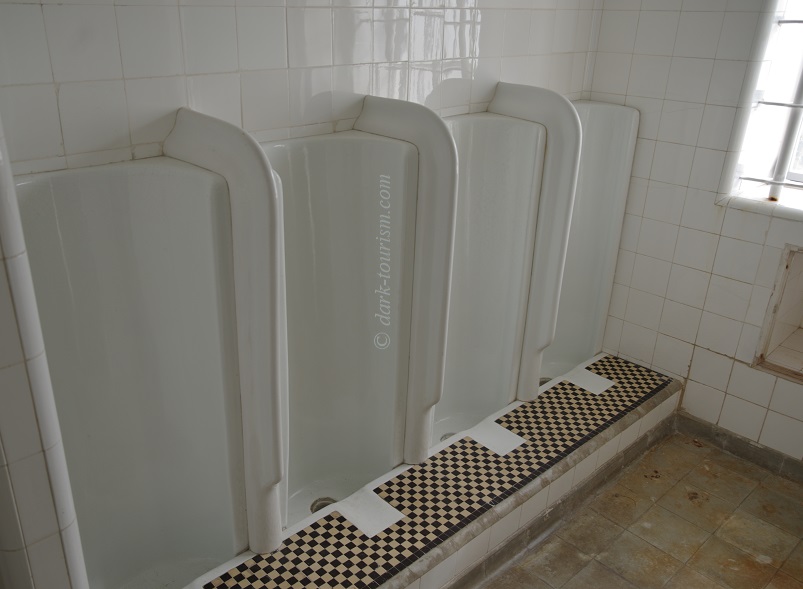
.
And in Australia at Adelaide Gaol, now also a museum, I spotted the intriguing contraption of a waste-disposal unit fashioned from an old flush toilet:
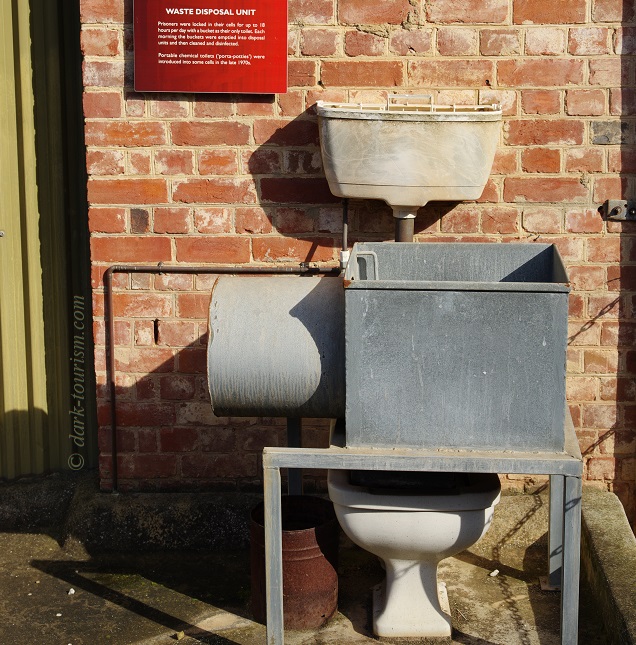
.
Toilets (or the lack thereof) are also a fact of life in war, so here’s another dark aspect. As an example I can offer this photo taken at the Passchendaele 1917 Memorial Museum near Ypres in Belgium (commemorating one of the bloodiest battles of WW1). It shows a reconstruction of a latrine inside a mock-up dugout, complete with a crapping dummy soldier:
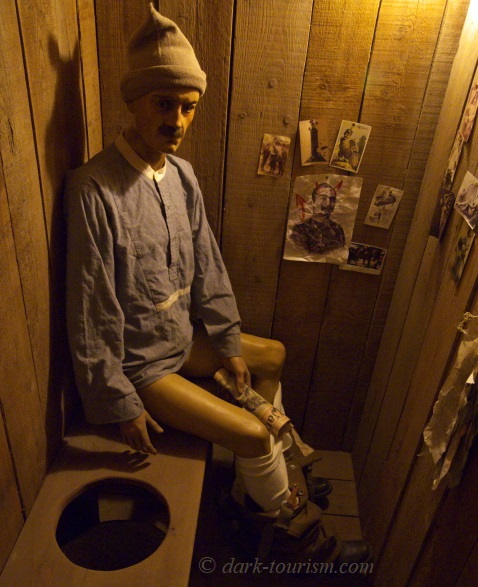
.
The next photo takes us into the WWII era and to the Channel Islands, more precisely Guernsey, which like the rest of the archipelago was occupied by Nazi Germany (the only parts of British soil they managed to capture) between 1940 and 1945. In the island’s capital St Peter Port is a relic from that time, the former German Naval Signals HQ bunker – and this place featured this lavatory:
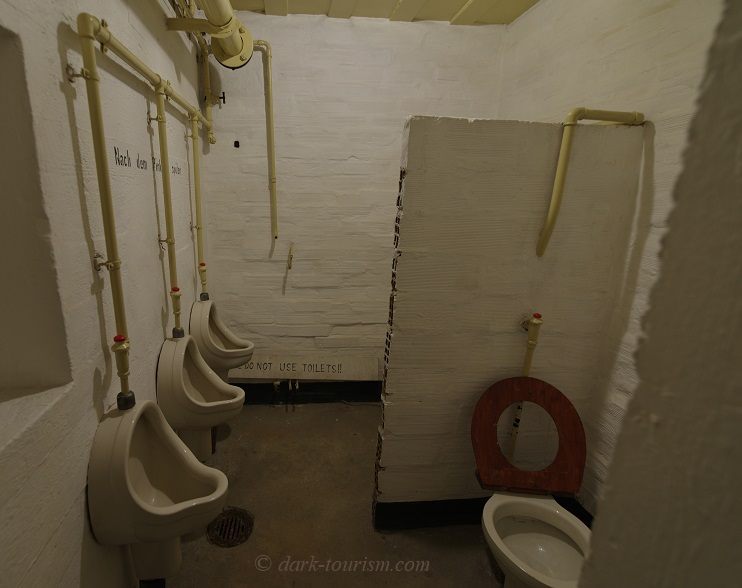
.
These facilities do look like they might still be functional – but spot the inscription on the far wall forbidding the use of these toilets.
Also from WWII is the block of toilet cubicles seen in the next photo, but this time these were for civilians, namely inside the Bourbon Tunnels in Naples which, like several other underground spaces beneath the city too, were used as an air-raid shelter during Allied bombing raids until September 1943:
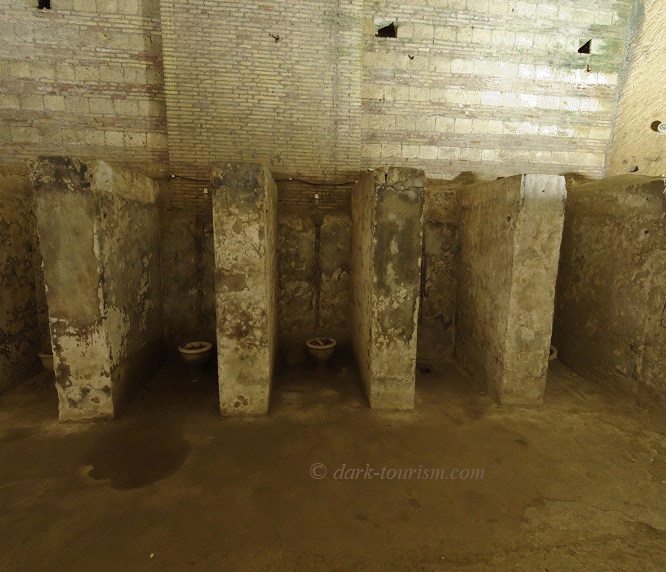
.
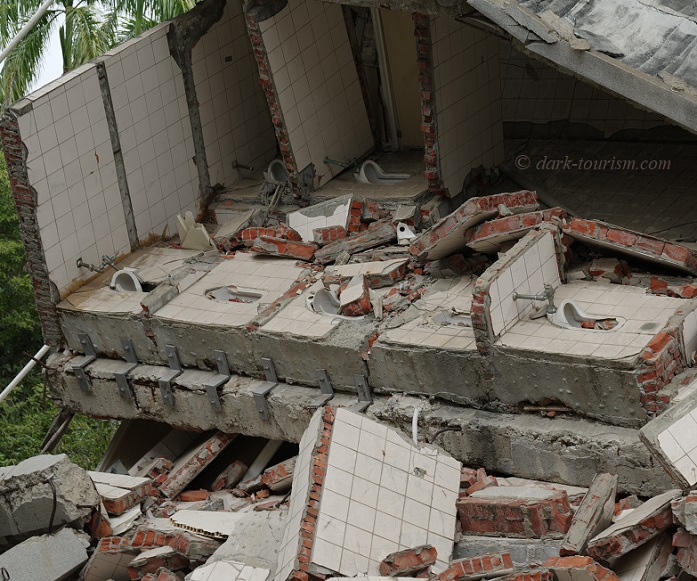
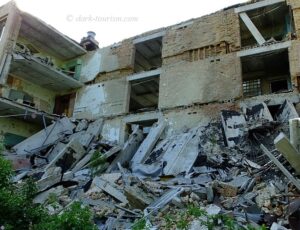
Moving away from wars, there are also reasons for places to be dark other than due to human violence, namely disaster sites. One type of natural disasters are earthquakes. On 21 September 1999 a catastrophic quake of an estimated magnitude of 7.5 shook the Taichung region of Taiwan. A shoddily built school on the edge of the city was largely destroyed in the quake. The ruins now form a central part of the 9-21 Earthquake Museum of Taiwan. At one end of the main block you can see exposed toilet facilities (squat loos, as are common in Asia):
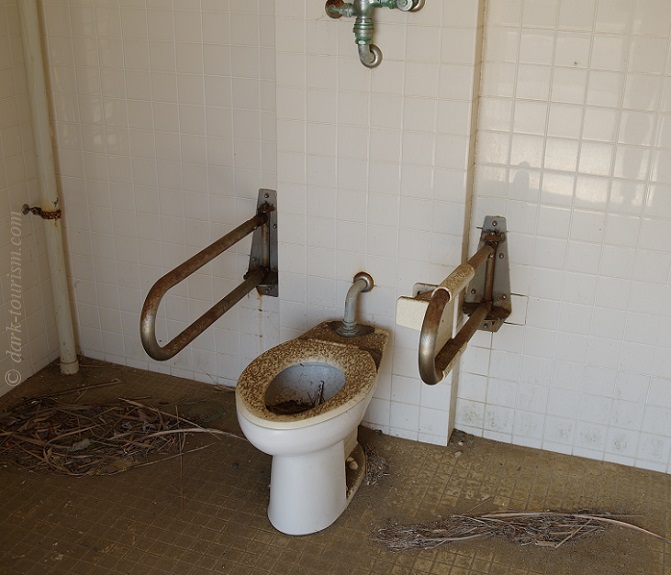
Another earthquake-prone country is Japan. On 11 March 2011, one of the most powerful earthquakes ever recorded shook the northern half of the main island Honshu and caused a massive tsunami. Here’s a photo taken in 2019 of an abandoned toilet inside the exclusion zone around the Fukushima-Daiichi NPP at what was once a fish farm:
Fukushima was a triple disaster, though: the tsunami also resulted in the meltdown at the NPP. This third element was partly human-caused – in the form of a design flaw, namely the fact that the back-up emergency generators were placed in basements, which the tsunami flooded thus rendering these generators useless.
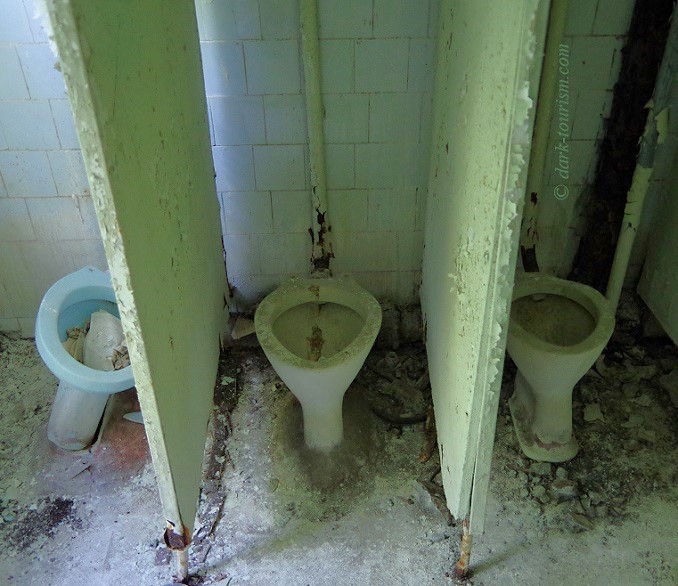
The Fukushima-Daiichi disaster was the second worst civilian nuclear disaster in history. The very worst was of course Chernobyl. Here’s a photo taken (in 2015) in the ghost town of Pripyat inside the exclusion zone, namely in the toilets of an abandoned school building:
.
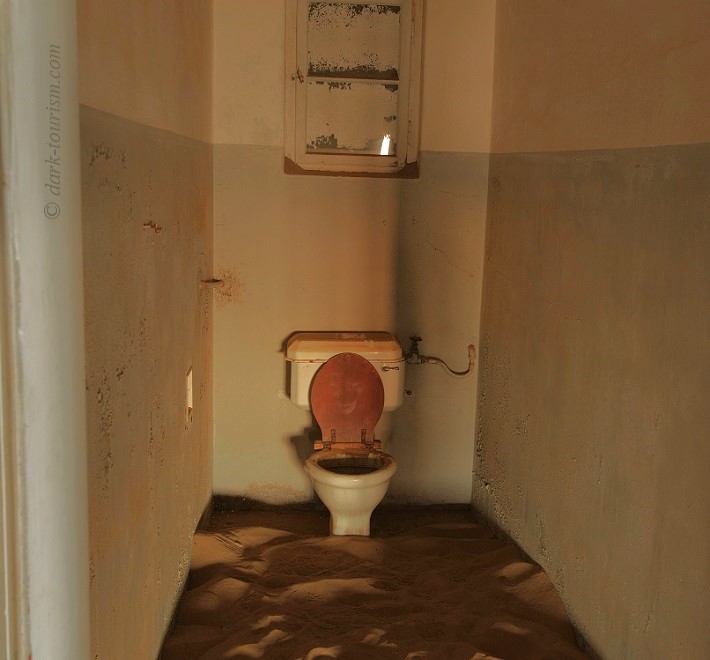
Another fabled ghost town is Kolmanskop in Namibia – and sure enough, when I was there I found a toilet there too – filled with reddish desert sand like so much of this highly atmospheric ghost town:
.
Less well known are a few more ghost towns deeper in the Sperrgebiet (closed territory) with all its diamond mining. One such ghost town I toured was Elizabeth Bay. And here there were some very basic facilities for the mine workers, including this mere bucket loo:
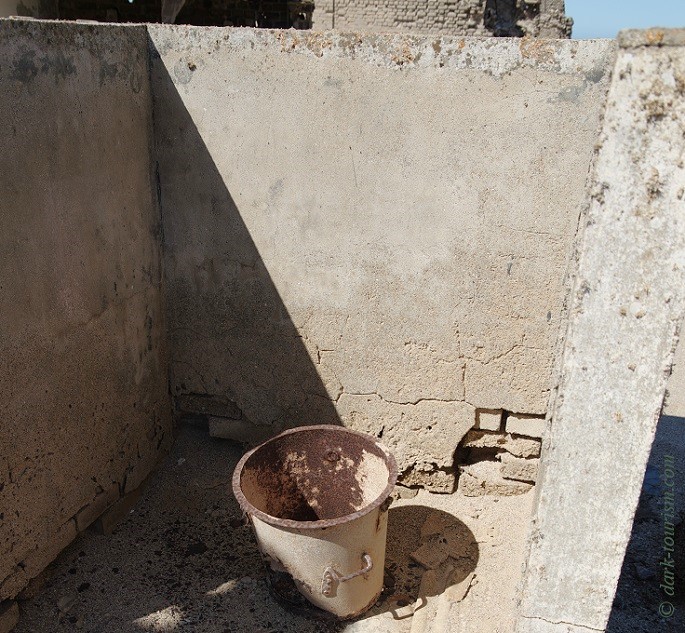
.
I also find toilets inside submarines somewhat spooky (and I don’t really understand how they work). Here’s a photo of the single loo for the entire crew of a Soviet-built submarine, U-434, which is now a museum vessel in Hamburg:
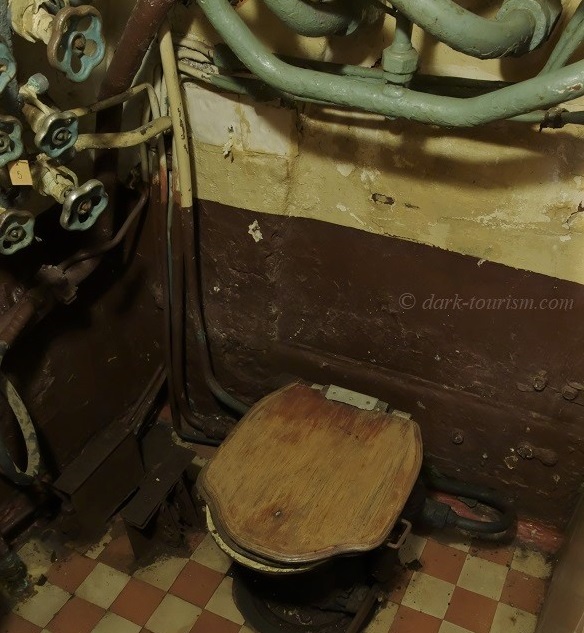
.
And here’s a photo of a toilet on HMS Caroline, a WW1-era light cruiser, the last surviving vessel to have taken part in the Battle of Jutland in 1916, now moored in a dock as a museum ship in Belfast’s Titanic Quarter:
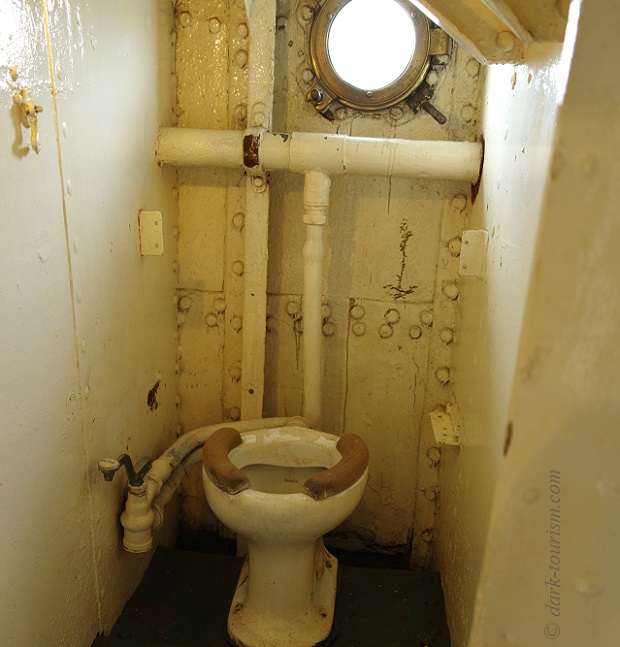
In Portsmouth in the south of England you can see the last remaining tank landing vessel that took part in the Allied D-Day invasion of Normandy, France. And this vessel, with the prosaic name of LCT 7074, also has onboard lavatory facilities:
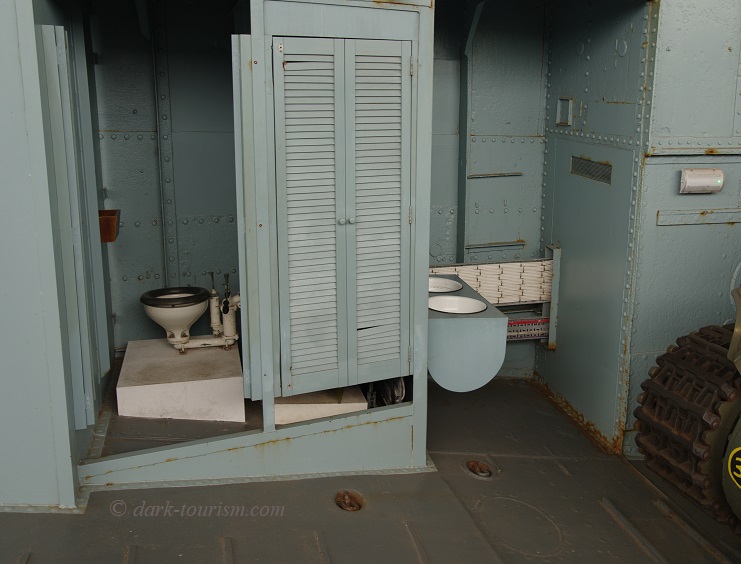
.
This craft is now the largest exhibit of the D-Day Story museum in the Southsea quarter of Portsmouth.
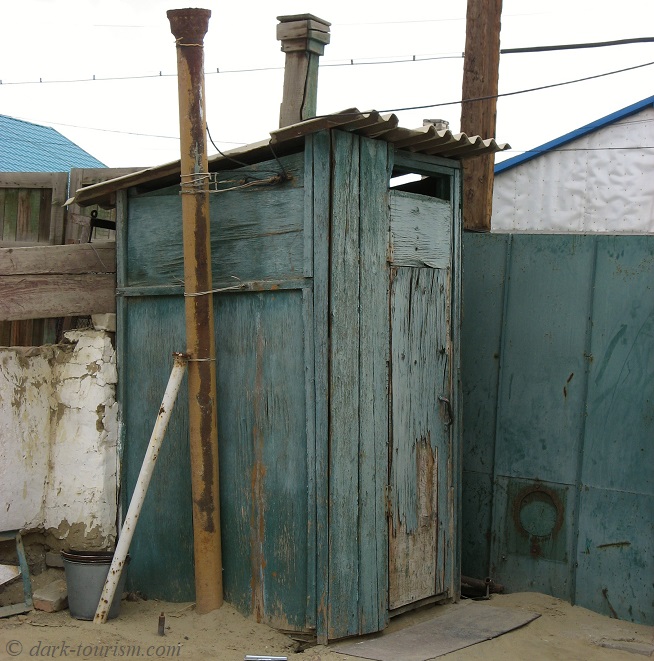
Possibly the worst toilet I ever personally encountered on my own travels was this outhouse loo at the homestay I had accommodation at (in 2011) in Aralsk, Kazakhstan:
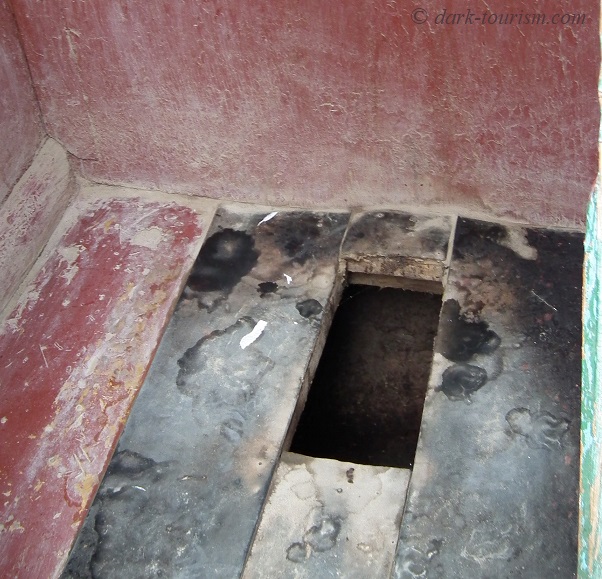
Inside was nothing but a hole in the floorboards, so it was stinky, you had to aim well and hope that the floorboards were sturdy enough to support your weight (fortunately that thought occurred to me only much later):
.
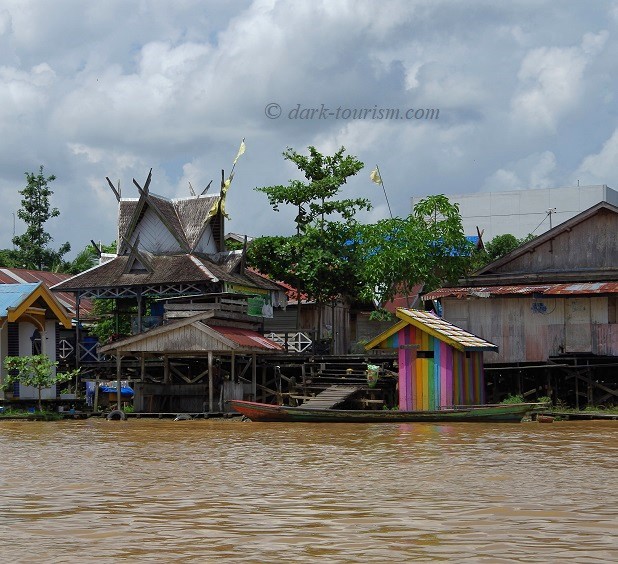
Outhouse toilets are also common in South-East Asia, like this brightly coloured specimen on a pontoon directly above the river in the town of Pangkalanbun on Kalimantan (Borneo), Indonesia:
.
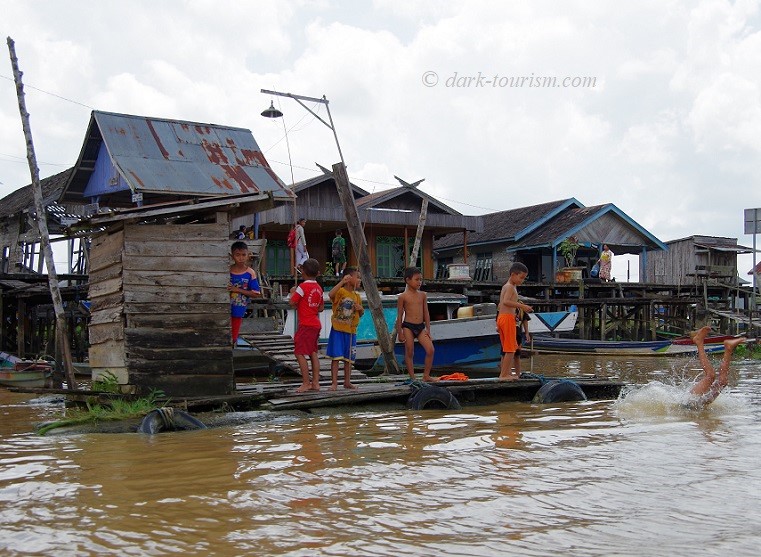
Obviously, all faeces go straight into the river, untreated. Nevertheless I saw children jumping into and playing in the river water right next to another such outhouse toilet:
.
I even spotted a man having a wash using that shitty water from the river, also right next to another outhouse loo:
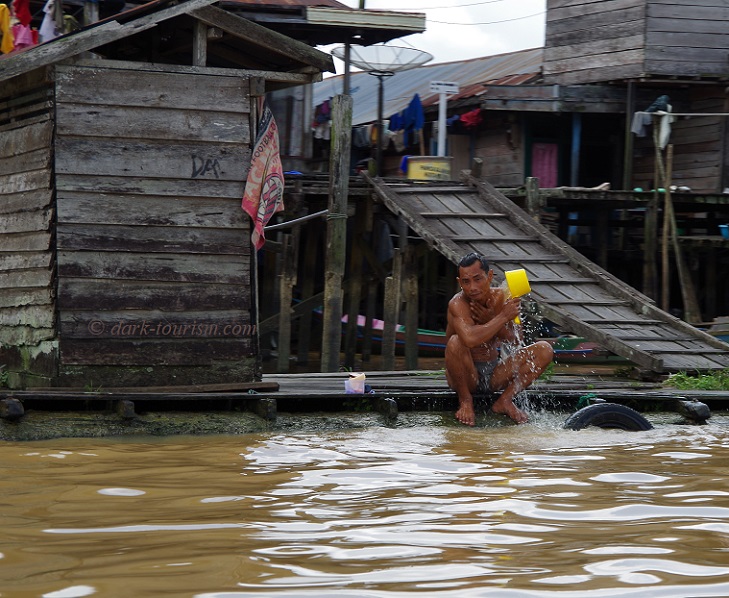
We are now moving into the funnier sides of the DT & Toilets theme. When I was in Suriname (the former Dutch Guiana in South America) I spotted this free-standing toilet without walls around it, which made me smile:
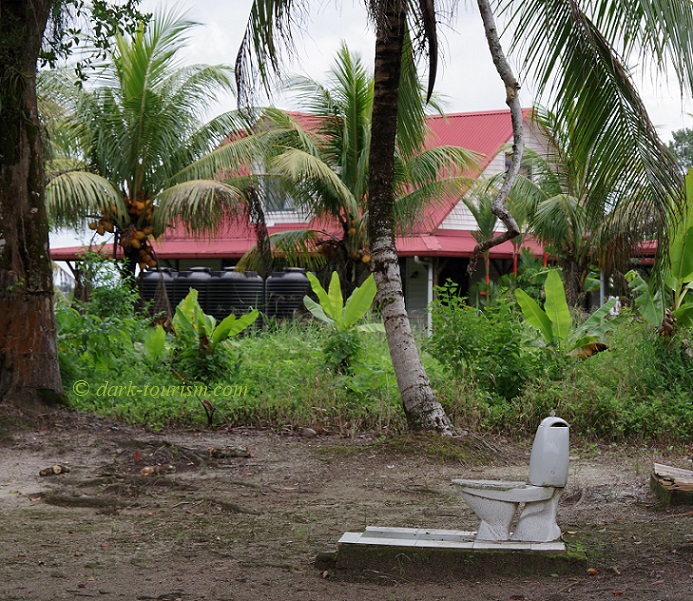
.
It almost looked like it could still be functional (I didn’t try) … unlike these broken open-air loo relics I spotted on Orford Ness last year:
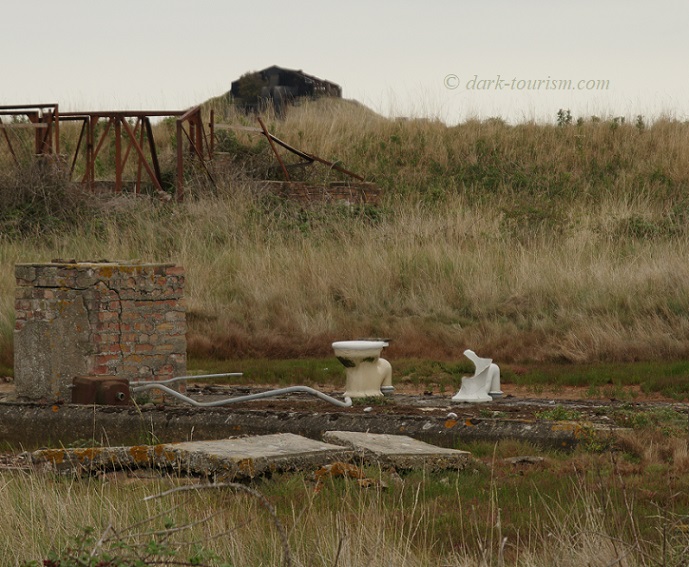
.
When my wife and I visited the Kirov House Museum in Saint Petersburg, Russia, in 2017, she needed the loo and when she came back she showed me this photo that she had taken at the museum’s ladies loo (same as the featured photo at the top of this post):
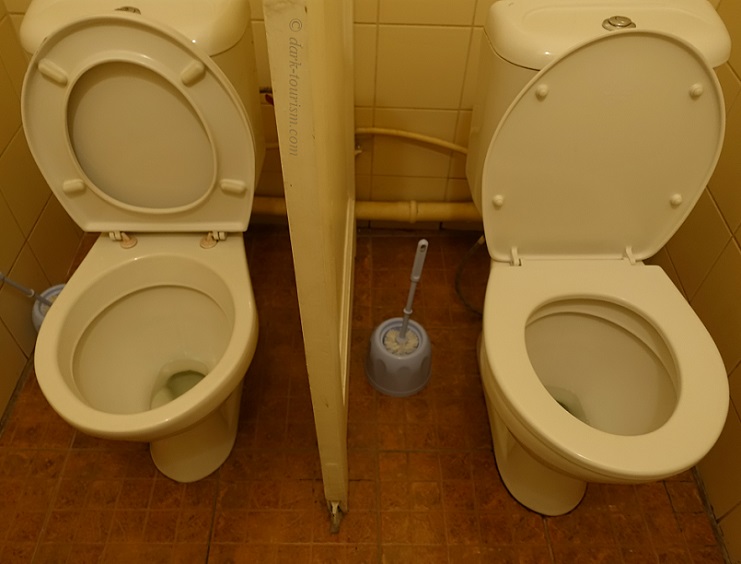
.
We then wondered whether this arrangement with hardly a partition wall between the two loos was deliberate … for women going to the toilet together (as they often tend to do) so that they could carry on chatting to one another whilst doing their business and even look into each other’s faces!
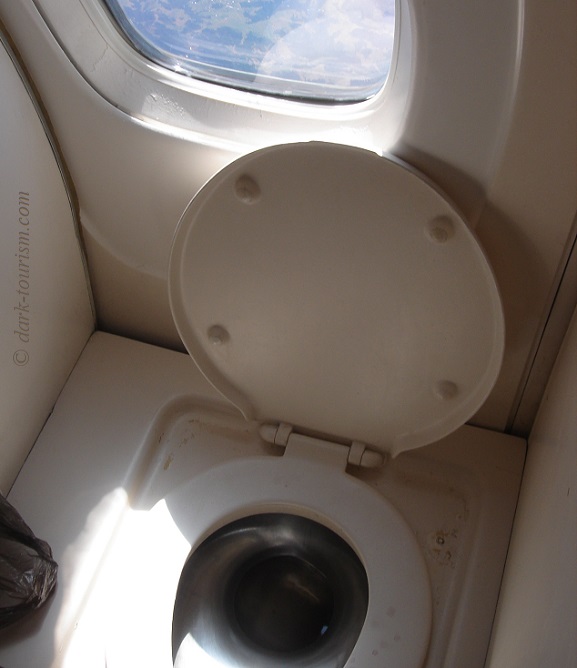
On another occasion, while on a flight to Moldova my wife came back from the plane’s onboard toilet and urged my to go as well – and take a camera … I’d see why as soon as I got in, she assured me. This is the picture I took:
.
It was indeed the only time I ever encountered a toilet on a plane that had a window! It was a rather small passenger jet, and I presume that the layout of the passenger compartment must at one point have been altered, so that the toilet ended up by a window, which they then just left as it was.
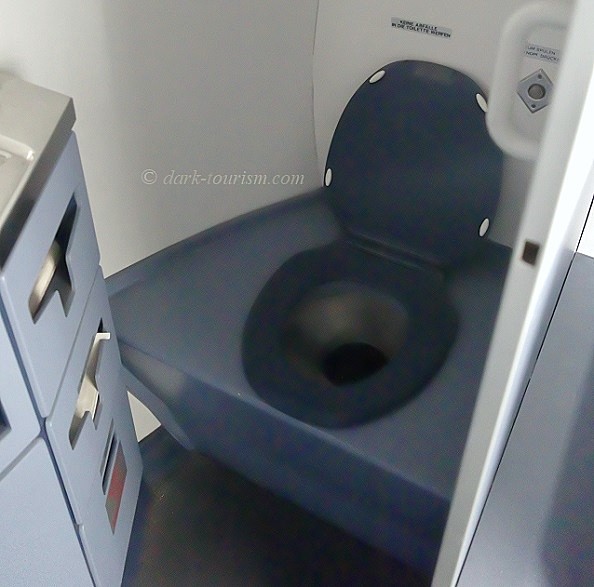
And finally, here’s another plane’s onboard toilet, in this case on one of the last surviving VFW 614 regional passenger jets, now on open-air display at the Aeronauticum naval aviation museum in Nordholz, northern Germany:
.
This plane was in use by the “Flugbereitschaft” of the (West) German air force (“Luftwaffe”), namely for the transport of high-ranking politicians. One of those was none other than Federal Chancellor Helmut Kohl, when he was flown in this plane to Berlin for the signing of the treaty on German reunification.
One member of the museum staff was on hand to relay anecdotes from this plane’s years of service (1977 to 1998). This included one involving, again, Helmut Kohl: allegedly, because of his size (and girth!), he wasn’t able to enter the plane’s toilet cubicle normally, but had to do so walking backwards in order to fit in.
And with that light-hearted note I shall come to a close. I hope you’ve enjoyed this post and agree that it was a suitable antidote to the previous post’s heavy and depressing topics. I might also revive the tradition of theme polls for readers to take part in before too long. I just have to see for what other themes I could still produce sufficient photo material. Bear with me.
.
2 responses
There is also the chemical toilet found in the three-person Royal Observer Corp bunkers. That had to be emptied by winching the bucket up the ladder.
guess that was fun 😉