Late on Wednesday I returned from my 12-day trip to Sicily. When I say Sicily, though, I should clarify that I only scratched the surface of that large Italian island, having visited only its two largest cities, Palermo and Catania, as well as three of the Aeolian Islands, but saw nothing of the rest of Sicily other than the bits of landscape I was able to spot from the trains and ferries I used. In terms of dark tourism (DT), however, I almost exhausted what there is to do and see (as far as I am aware). The focus on DT was less intense on this occasion – so there was also room for some mainstream tourism and, in particular, the culinary side of travel, which in the case of Sicily is, or should be, centre stage. Rarely have I eaten so well so consistently while away travelling. It’s a small miracle that I only put on a single extra kilo of weight 😉
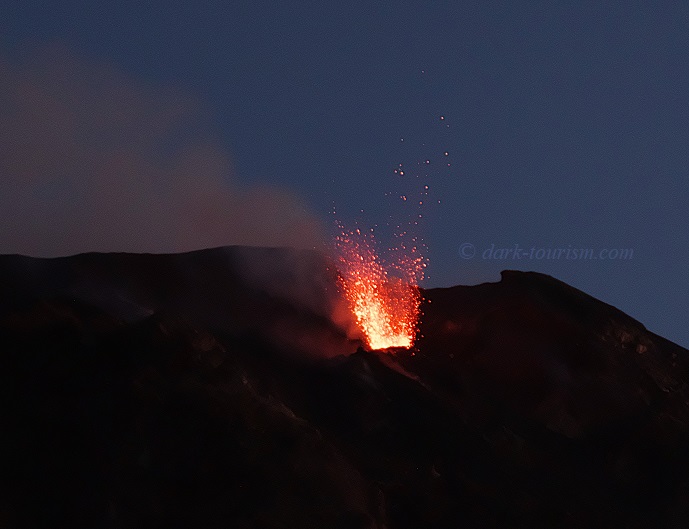
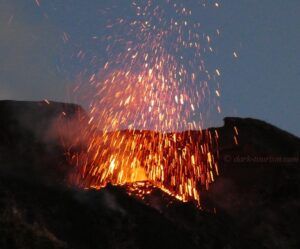
The main inspiration for going on this Sicily trip was “volcano tourism”, in particular seeing the continually active volcano Stromboli erupt by dusk and night. That was the definitive highlight of the entire trip – and hence one deserving of a separate extra Blog post to follow soon with several photos of Strombolian eruptions. Here, I give you just one single little taster photo:
.
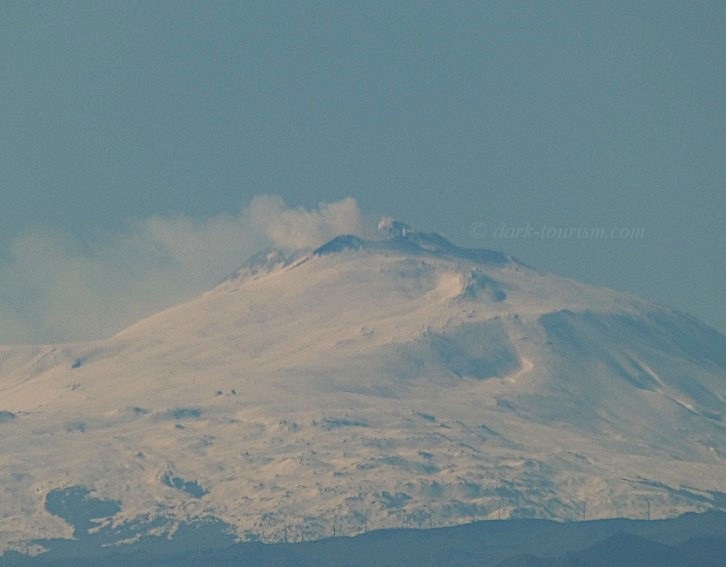
Sicily’s second most active volcano is Mount Etna, also its largest mountain and Italy’s highest south of the Alps. I didn’t go up it, as it was still largely covered in snow, but saw it from a distance. First from the ferry that took me to the Aeolian island of Lipari:
.
This is a heavily zoomed-in photo and hence not very clear, but you can make out plumes of smoke coming from the summit crater(s). Otherwise, Etna wasn’t so active at that time.
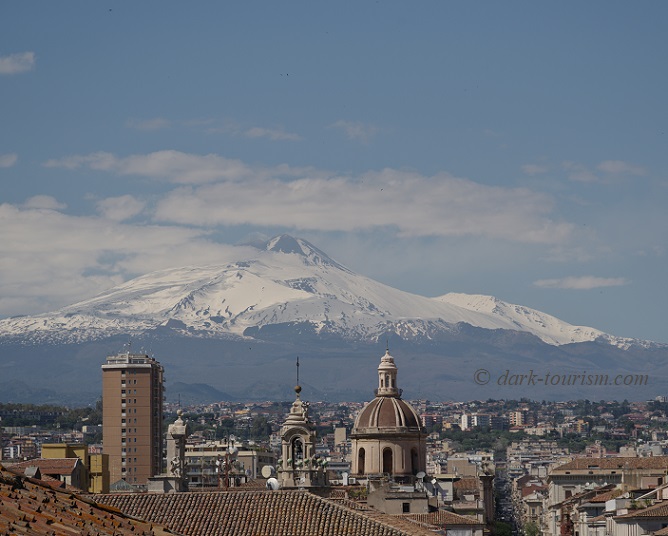
I got a better view of Mt Etna later in the trip, namely from Catania, more precisely from the roof terrace of the Museo Diocesano next to the cathedral (same image as the featured photo at the top of this post):
.
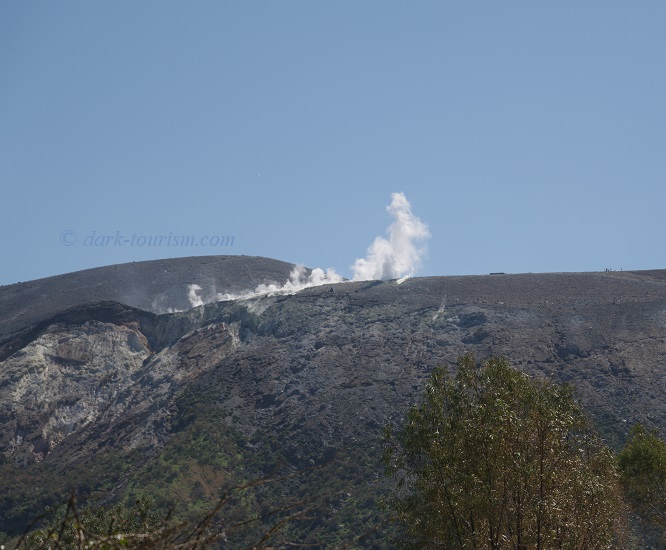
There’s yet another active volcano in the Aeolian Islands, namely on Vulcano, so named after the Ancient Roman god of fire, whose abode this island was believed to be – and that’s where the term ‘volcano’ derives from. The island’s “Fossa di Vulcano” is nowhere near as active as Stromboli or Etna, having last erupted well over a century ago in 1888-1890. Nevertheless it’s still smouldering and emitting sulphurous gases, as seen in this next photo:
.
I had intended to hike up to the crater rim, but when I got to the trailhead, the warning light installed there was flashing red, meaning one was not allowed to go up. And the sign with the rules is quite clear. So I obeyed and instead just had a good walk around the foot of the mountain and the island’s main village. However, I saw other people ignoring the rules and going up there regardless – and you can just about make out a small group of people on the crater crest towards the right-hand side of the photo above.
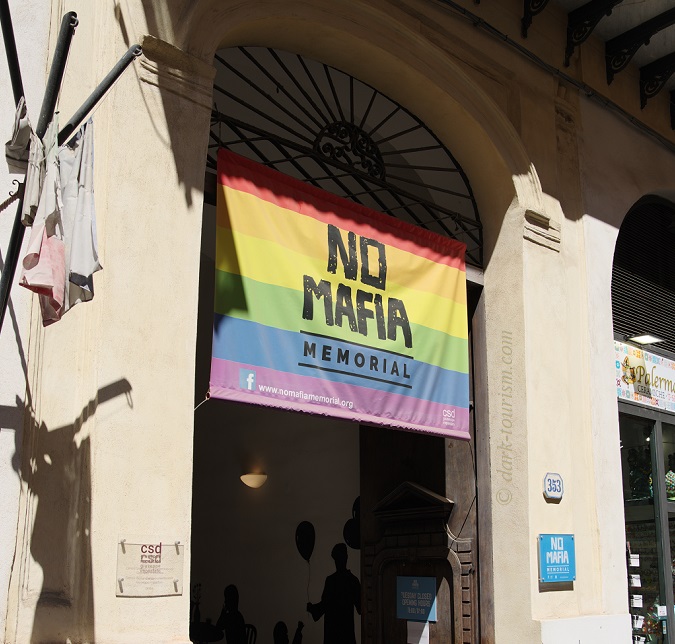
But my first port of call on this trip was actually Palermo, the capital of Sicily. The name of this city alone has a dark ring owing to its association with the Mafia (going by the name of Cosa Nostra here). But Palermo is also famous for its brave resistance and fight against the Mafia. Their crimes and the efforts to stall them are documented in the private “No Mafia Memorial”:
.
.
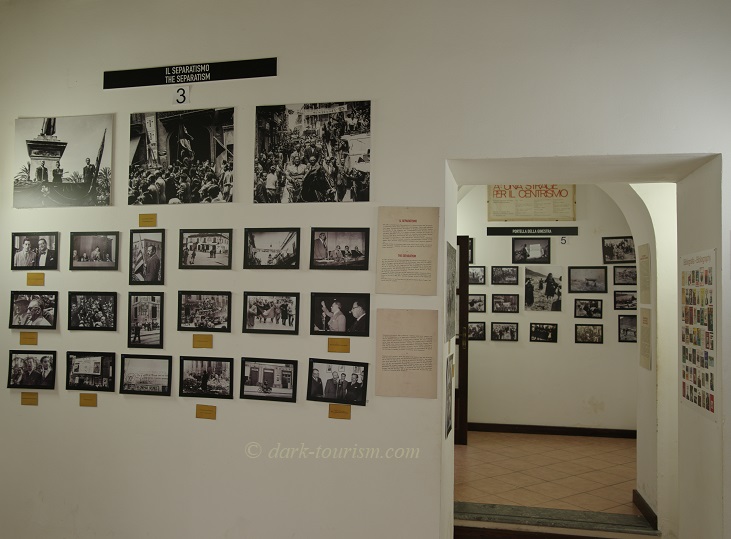
Inside, there are hardly any concrete artefacts, but countless photos, mostly in black and white plus a few explanatory text panels:
.
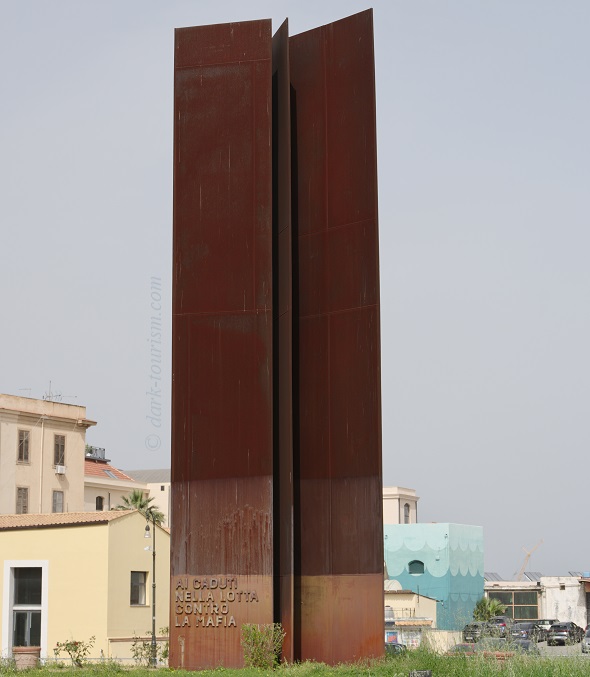
Other references to the Mafia include a monument near the new harbour development. It’s dedicated to all those who lost their lives in the fight against the Mafia:
.
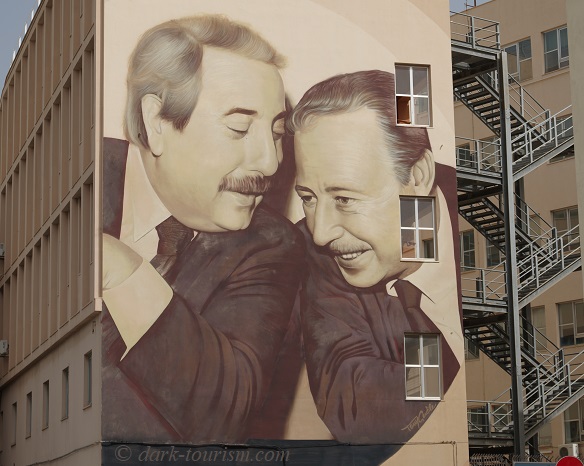
Also near the harbour and well visible from the yacht marina is a large wall mural depicting the Mafia-hunter judges Falcone and Borsellino, who were murdered by the Mafia in 1992:
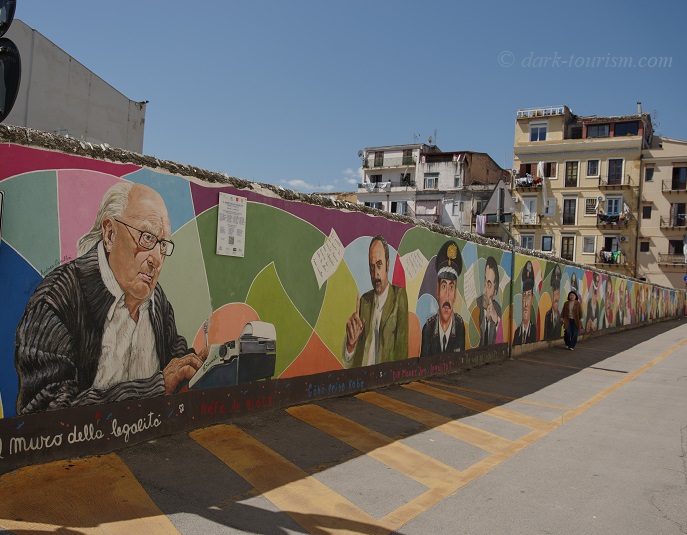
Closer to the historic centre of Palermo is another wall mural, this time covering a long stretch of low wall, “moro della legalita’, or ‘Wall of Legality’. It depicts various individuals, from ordinary police officers to journalists, who played their part in the fight against the Mafia:
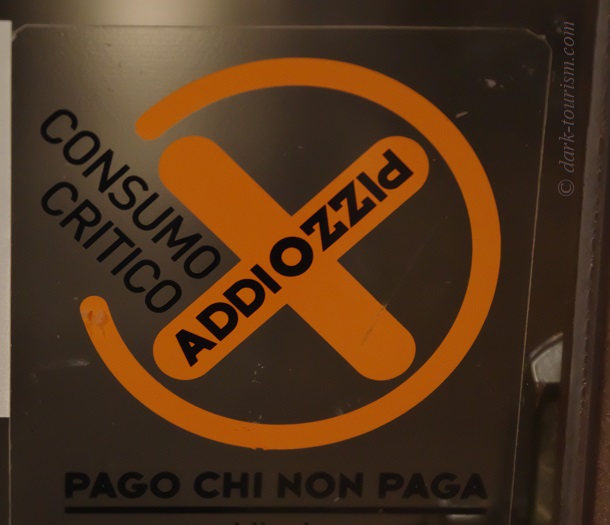
There’s also an organization/association called “Addiopizzo” (‘pizzo’ is the local word for extortion money, and ‘addio’ means “goodbye to”). They offer various tours for tourists to educate them about the Mafia and the fight against it, including a three-hour “No Mafia” walking tour in Palermo. Unfortunately, though, these tours ran at times I couldn’t make, so I just walked along the route by myself to take the photos shown above. OK, I missed out on the narrative, but at least I got to see the sights.
The “Addiopizzo” logo can also be spotted in the windows of shops and restaurants which are members of the organization and refuse to pay “pizzo” … having these signs in the window can help customers and patrons to make a conscious decision to support anti-mafia businesses. I ate in some of those restaurants (though not consistently only in those), and this is the logo/symbol I spotted at one of them:
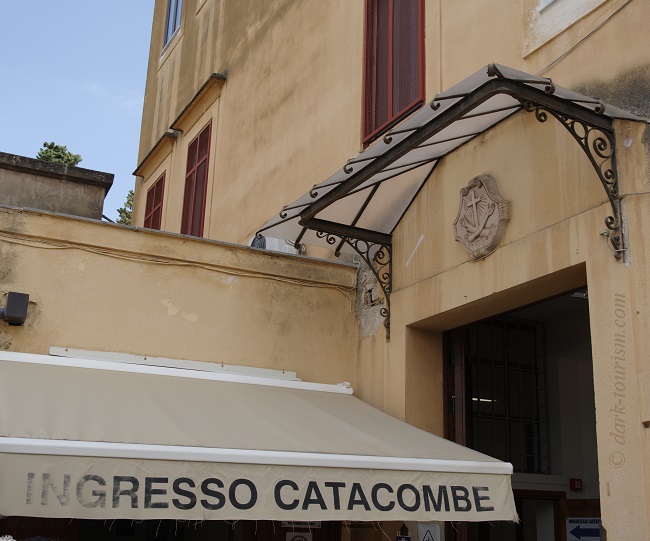
The other main dark draw of Palermo is the “Catacombe dei Cappuccini”, i.e. the Capuchin Catacombs. I’ve been to several similar places in different parts of the world, but this one really is the “mother” of all catacombs, housing several thousands of bodies, some mere skeletons, others semi-mummified. And all of these are clothed, some even in suits or pretty dresses! There would have been plenty of unique photo ops, but unfortunately photography is not allowed inside the catacombs, and the rule is enforced with CCTV cameras and security guards parading up and down the corridors). So I obeyed and did not make any attempts to take surreptitious pictures. I also understand that loads of tourists taking snaps of the dead bodies (or worse: selfies with them) could be seen as disrespectful. So I can only give you a photo of the entrance:
To partially make up for the no-photography rule I purchased a book about the Catacombs that features many professional photos. Here is a photo of the cover:
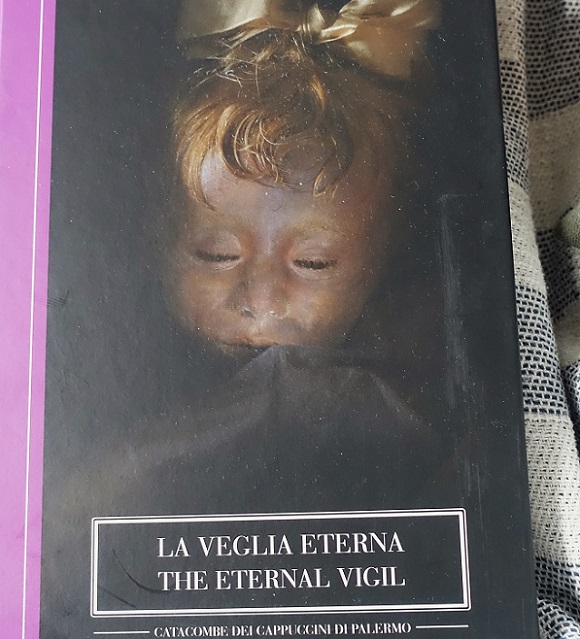
The photo on the front of the book shows the most celebrated “resident” of the catacombs, the skilfully embalmed body of Rosalia Lombardo, who died in 1920 at the age of just under two years old. She was also one of the final bodies admitted to the catacombs. She is definitely the “star attraction” and I saw some visitors heading straight there, largely ignoring all the other bodies. Unfortunately, however, you do not get to see her in all her beauty as on the book’s cover photo, as her open coffin has now been placed within a sealed outer sarcophagus with a curved glass top, so that reflections on the glass from the lighting above make a clear view of the little body pretty much impossible.
Right next to the catacombs and the monastery is a regular cemetery, where there was no restriction on photography in place. So I explored this a little as well. One of the photos I took there shows this rather spooky weathered bust atop one of the tombs:
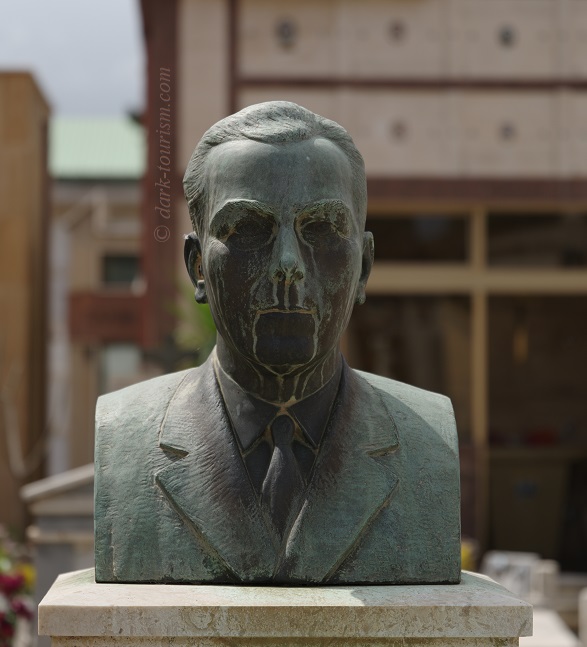
My second city destination in Sicily was Catania on the Ionian coast facing east. Just north of the city Mt Etna always looms large – as you’ve already seen in the third photo above (same as the featured photo at the top of this post), repeated here once more as a Catania intro pic:
In terms of dark tourism, Catania had for a long time not even been on my radar. But when I was there I made this chance discovery:
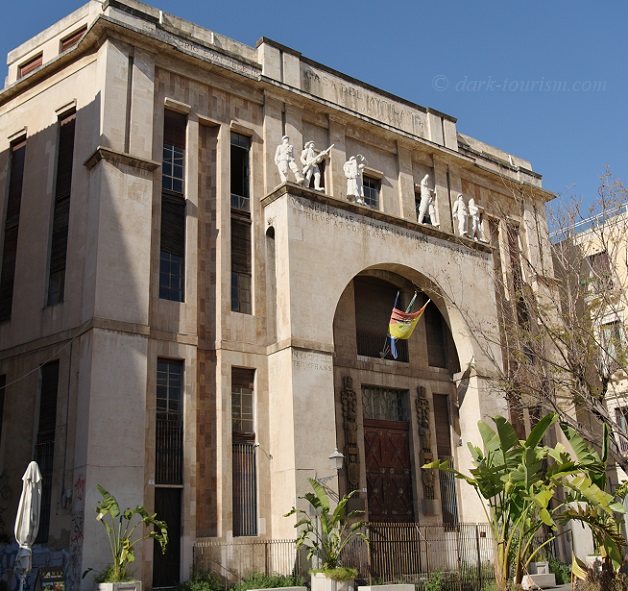
This is a fascist-era memorial to the fallen, and mutilated, soldiers of Italy, erected in 1937-39 to be inaugurated, somewhat ironically, just before the beginning of WWII. I read somewhere that this structure had long been neglected and vandalized – and older photos you can find online seem to confirm this. But when I was there the front façade and the row of six white soldier statues seemed to have been recently renovated. The inside, though, was still not accessible.
What I had found in my preparations for the Sicily trip, on the other hand, was that the city features Sicily’s premier WWII museum. It’s called “Museo Storico dello Sbarco in Sicilia 1943”, indicating that it is specifically about the Allied landings on Sicily in 1943 under the code name “Operation Husky”. In actual fact, however, it is about much more than that. An intro film outlines the path of Italy into WWII, its ill-fated efforts in Africa and the Balkans and only then turns to the landings. The museum also covers the aftermath, the pushing of Nazi German troops out of Sicily and the end of the war. While there are lots of smaller artefacts accompanied with bilingual labels and text panels, the main characteristic of this museum is its many large life-size installations, such as this one of a bombed city street:
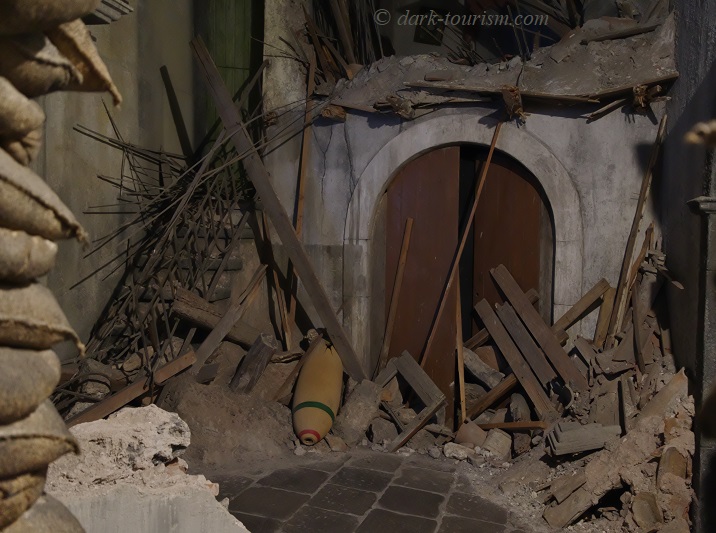
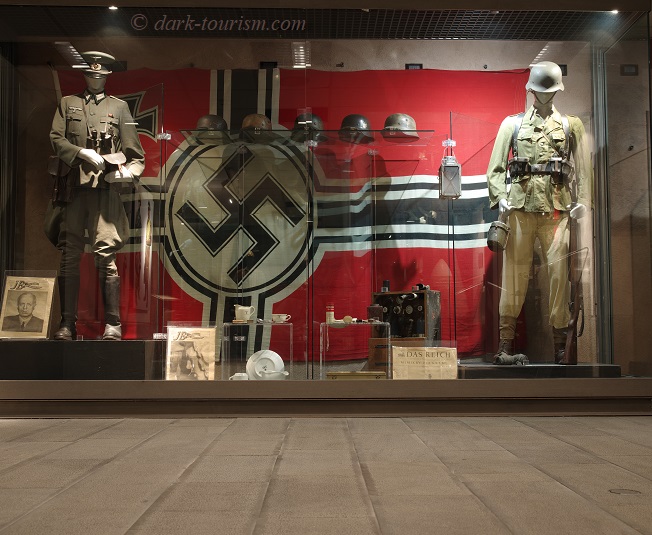
Unsurprisingly, there is also plenty of Nazi symbolism, together with uniforms, weapons, medals and whatnot:
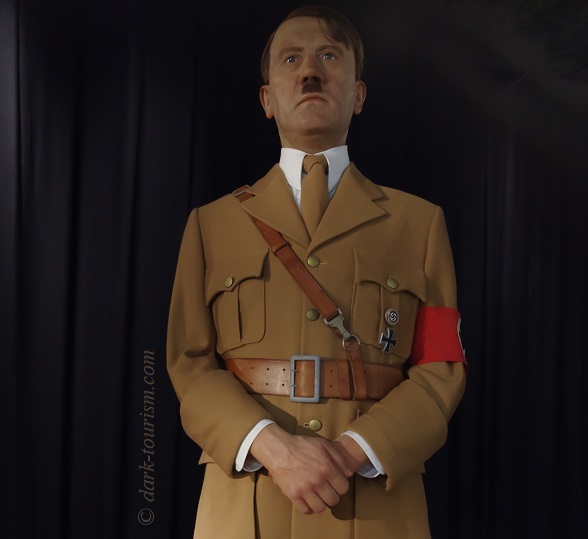
There’s even a full life-size wax model of Adolf Hitler, looking eerily realistic:
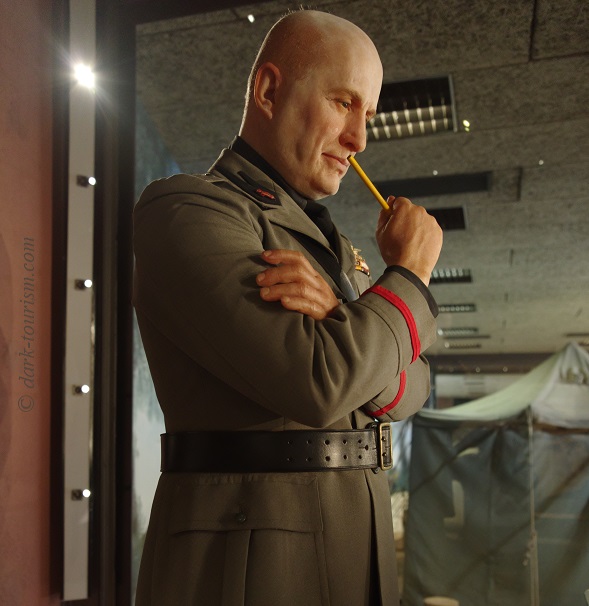
Naturally, if you have a Hitler, Italy’s own “Duce” Benito Mussolini has to be represented too, and he is, with yet another realistic-looking wax model:
A real remnant of WWII can be found in a rather hidden location right in the old centre of Catania, namely at Porta Uzeda next to the cathedral:
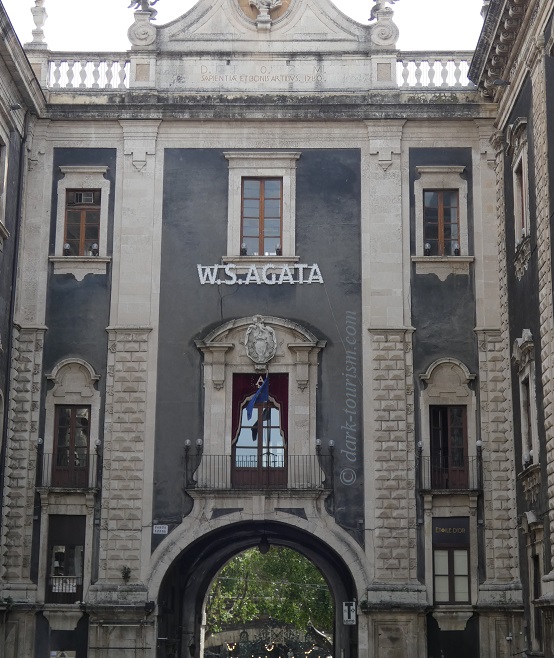
In the archway is a small niche with a painting of Jesus next to which is a plaque:
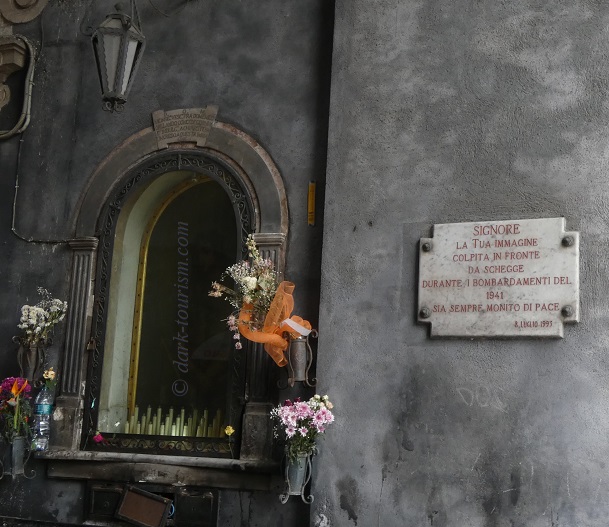
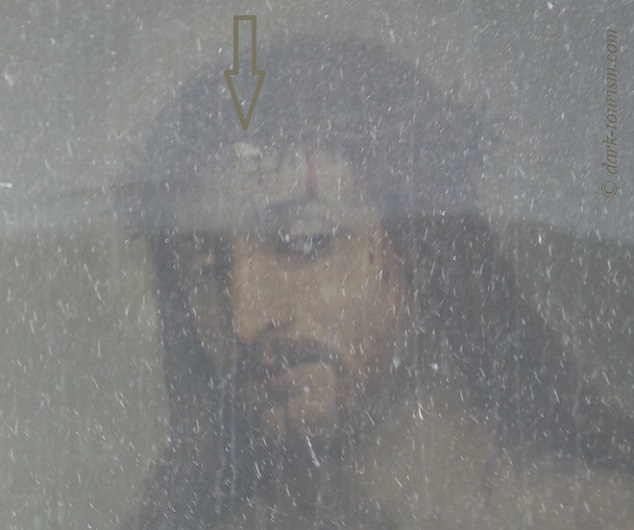
The plaque’s text translates as “Lord, may your image, struck in the forehead by shrapnel during the bombings of 1941, rest in peace”. And indeed if you look closely you can see a little splintered hole in the brow of Christ – difficult to make out because of the dirty glass protecting the painting, so I indicated the spot with an arrow:
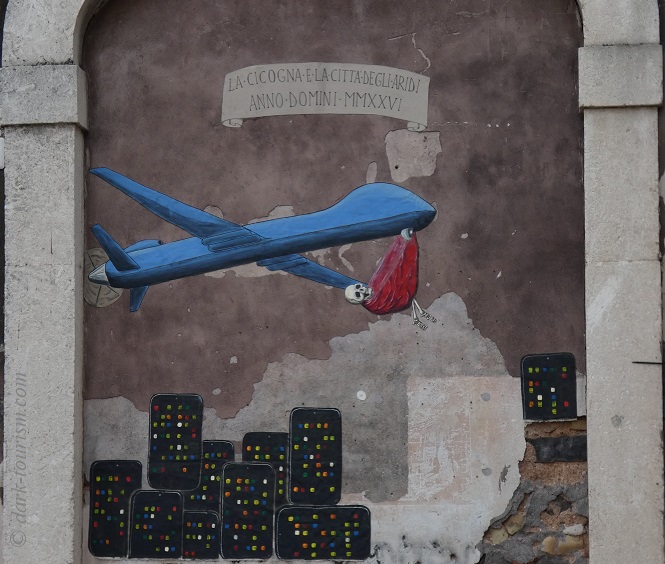
I also spotted a reference to modern wars (with drones) in this wall mural opposite the Monastero dei Benedettini di San Nicolò l’Arena:
I have one more place to feature here, though I didn’t actually go to it myself but only saw it from the ferry between Lipari and Stromboli:
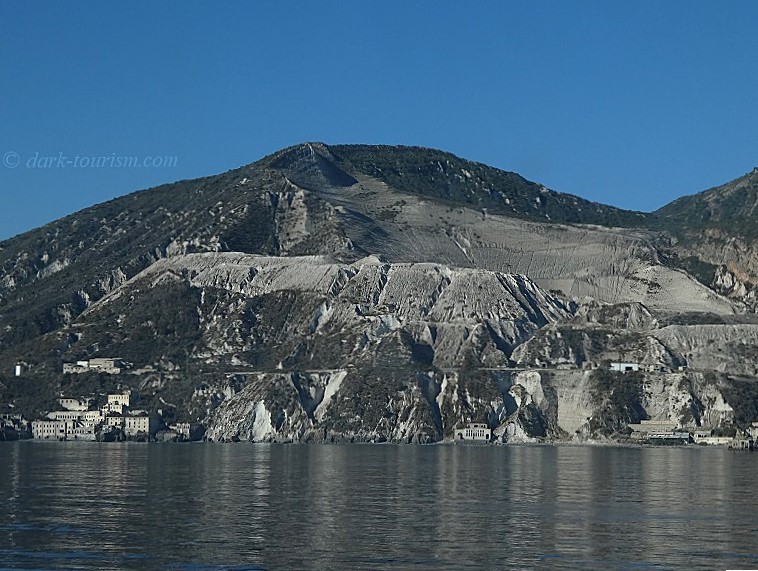
This is a large former pumice mine on Lipari. Zoomed in more you can make out abandoned industrial complexes that look enticing from an urban explorer’s perspective:
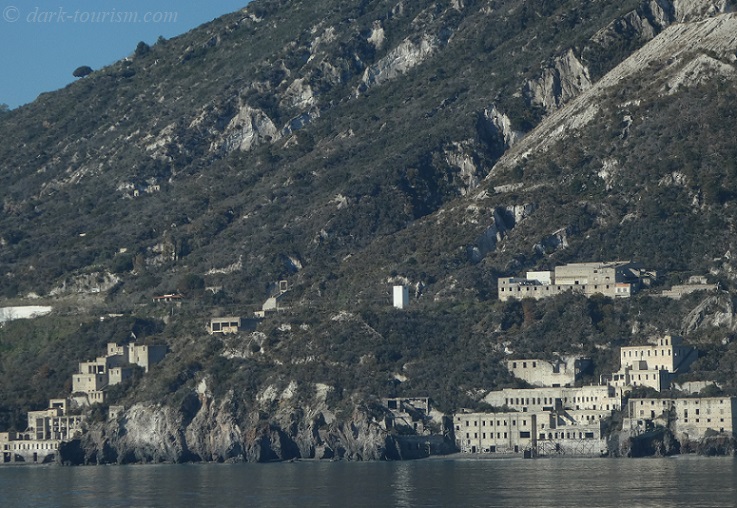
When I researched the place later, I found that not only does it indeed present cool urbex potential, there’s even a “pumice canyon” you can walk through. Should I ever return to Lipari, this ex-mine, the canyon and the abandoned industrial buildings would be highest on my priority list!
But with this I shall come to a close. I hope you’ve enjoyed reading this overview post about my trip to Sicily. And you can look forward to a more specific Stromboli post that will follow soon and will feature several quite spectacular photos of the volcano’s firework action that was the highlight of this Sicily trip.
2 responses
when I was in Sicily I too wandered around the Catacombs, I found them fascinating, loved Palermo, went up Etna and enjoyed Catania as well
all the best Phil
… and it’s a foodie’s paradise, isn’t it? When were you there?