As promised in the previous Blog post that gave an overview of my recent trip to Sicily, now here comes the more specific post about what was the definite highlight of that trip: seeing Stromboli erupt (below you’ll find several more photos of the natural fireworks show!). The guided hike to the 400m viewing point was actually the very first thing I booked for my Sicily trip and only then built everything else around this.
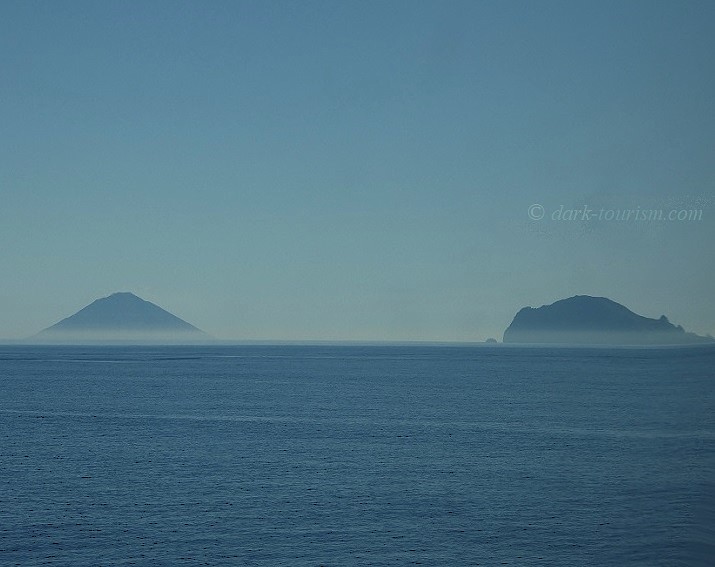
First you have to get to Stromboli, of course. I planned the trip in such a way that I’d have two nights on Lipari, the largest and most populous of the Aeolian Islands, and from there got a morning ferry crossing to Stromboli (via Salina and Panarea). On the island I had two nights’ accommodation booked, to provide two chances for hiking to the volcanic action. From the ferry leaving Salina I took this photo, the cone of Stromboli is on the left:
.
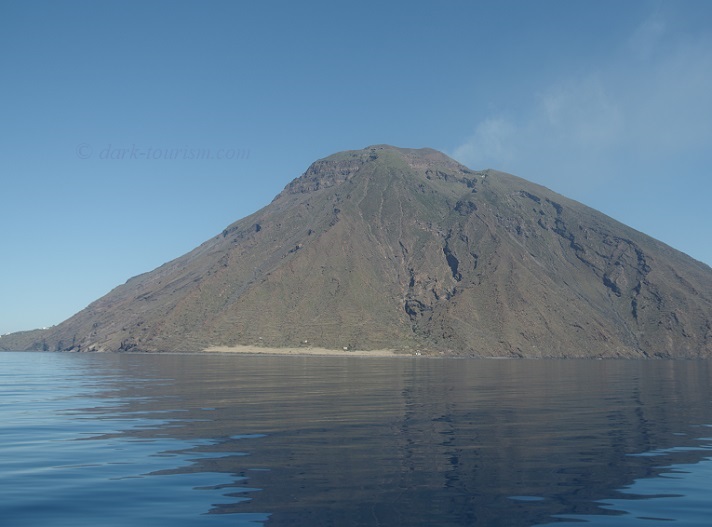
The ferry first stopped at Ginostra, the smaller settlement on the western point of the island, where only one passenger got off the boat and none embarked. I took the following photo of Stromboli closer up on the approach to Ginostra (parts of which you can just about make out on the left edge of the frame):
.
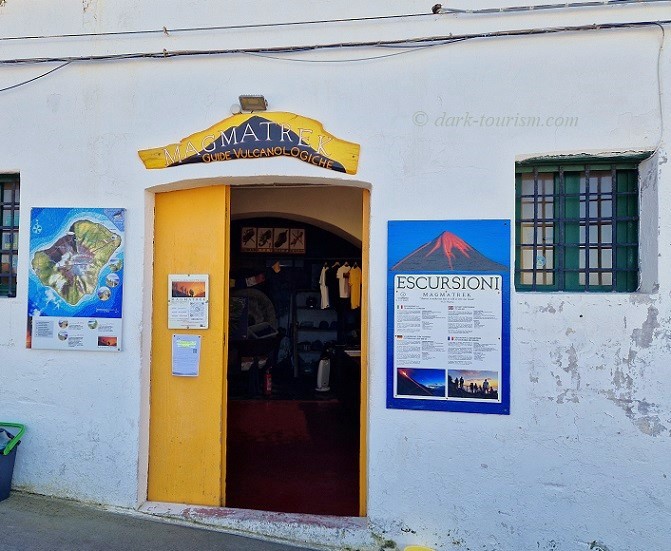
Then the ferry proceeded to the main port at the principal settlement, San Vincenzo. After disembarking, my wife and I headed straight to the office of the volcano hike’s operator, “Magmatrek”, located in the centre of the village:
.
Here we checked in and paid the fee for the guided hike (30 EUR per person). We were told to come back for half past four for the briefing and start of the hike. That gave us enough time to check into our hotel, go for lunch (as we knew there would be no opportunity for dinner that evening, given the time the hike takes) and have a siesta before making our way back to Magmatrek’s office.
It was getting busy there, and it soon became apparent that at least three separate groups were being assembled. The hike is advertised as being for “small groups” only, but what they didn’t make clear is that several groups go up at the same time. So it was much busier than I had expected. At the viewpoint there were probably around a hundred people. So it was more touristy than anticipated.
All participants were given a hard hat to carry on the hike – only to be actually put on if necessary (e.g. when there’s a sudden large eruption out of the ordinary), but having one at the ready was mandatory. So was bringing a good torch and/or headlight for the hike back down in the pitch-black dark. I was also handed a walking stick, which indeed proved very useful on the steeper parts of the trail. Of course you should also wear good sturdy boots and appropriate clothing and take extra layers to put on after dark, when it gets quite cold in April still, certainly at the exposed 400m point.
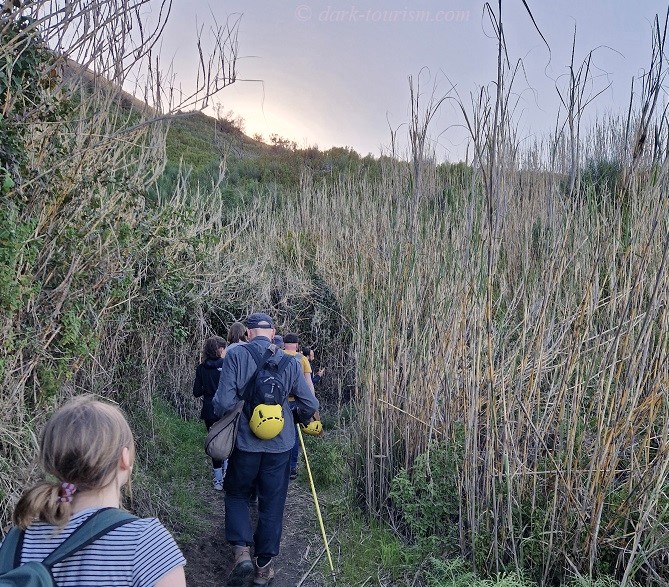
Our group with an English-speaking guide was the third to set off. After an initial climb to ca. 200m above sea level the path flattened out for a while so it was possible to take the odd photo:
.
Doesn’t look so bad at this stage, does it? But I’d be lying if I claimed the hike overall was easy. There were several steep and somewhat precarious sections as well and the two hours it took to hike to the 400m viewpoint were quite hard work. At least we took breaks every half hour or so, which were welcome, and also gave our guide the opportunity to present some volcanological details about Stromboli and the Aeolian Arc that it is part of. I won’t go into the details here, but you can find the most important aspects in the existing stub chapter for Stromboli on my main website (soon to be expanded into a proper full-length chapter).
When we arrived at the viewing point at 400m above sea level, all sitting spaces were already taken up by the groups who had set off before us, but I still managed to position myself at the railing at the front of the area. And so we waited for sunset and for the nightly fiery show to begin. At this point the main active crater at the top (we were told there were currently three summit craters) was just smouldering and emitting white gases:
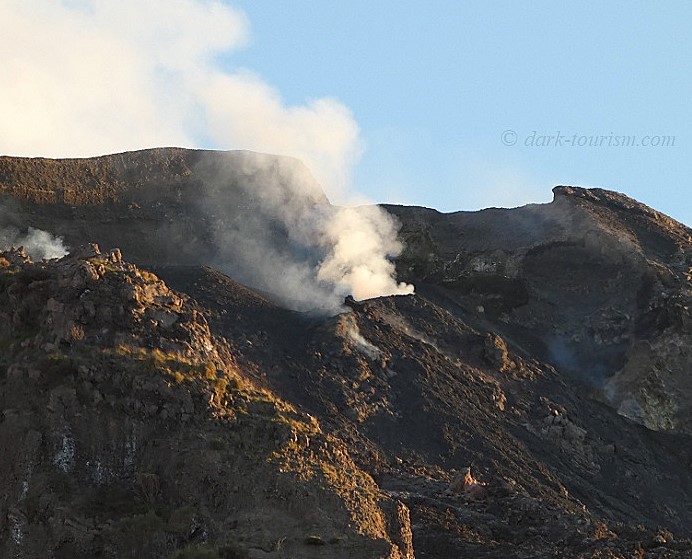
.
Looking down from the viewing platform you can see the steep slope (called “Sciara del Fuoco” or ‘stream of fire’) down to the sea:
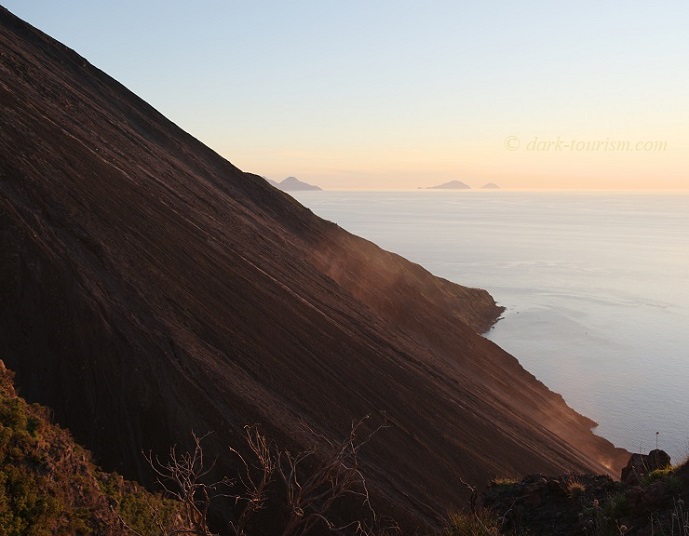
.
The first of the bigger bursts I almost missed as I was still setting up my cameras, but I managed to capture some later ones (see below). Much of the time, the crater is just sputtering away with smaller amounts of red-hot rock ejected not especially high:
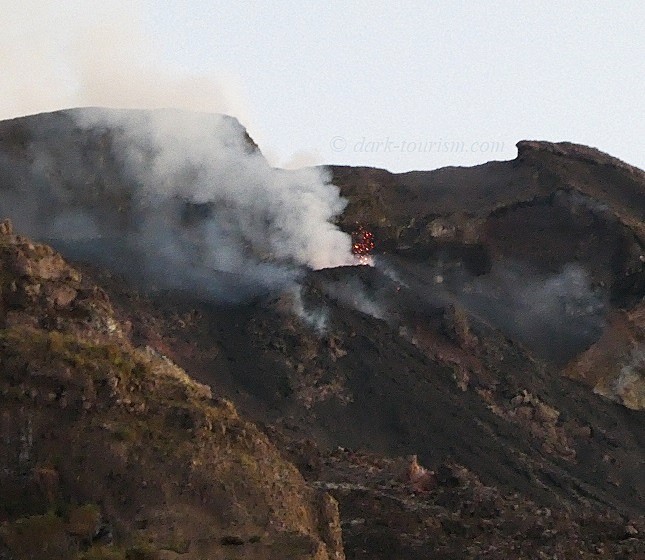
.
Bigger ejected pieces then roll all the way down the Sciara del Fuoco (and that’s of course what gave it its name):
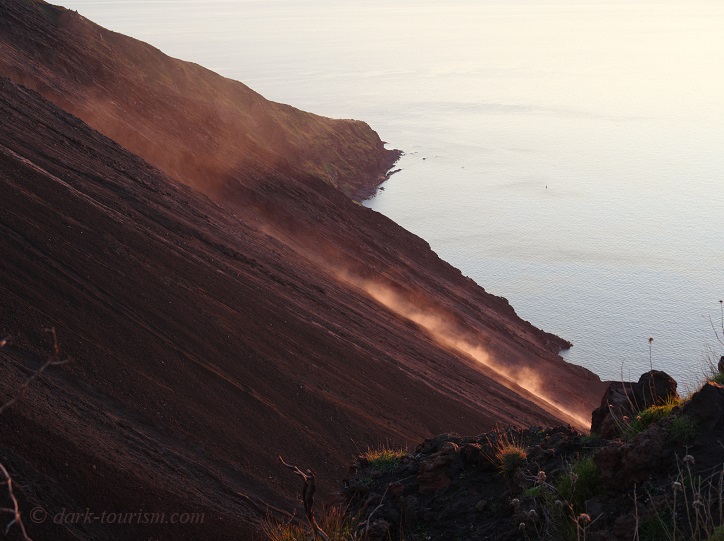
.
Capturing Stromboli’s fiery action on camera is actually quite a challenge. For one thing, there’s no way of predicting exactly when there will be a larger burst. And they move so fast – and for just a second or two, so it’s hard to catch the right moment. You’re also still quite a distance from the crater. I had contemplated obtaining a long lens for my dSLR camera, but a) they are very expensive (they cost thousands of euros) and b) very heavy … and I already had quite a bit to schlep on this hike. So instead of an extra lens I decided to invest in a new “superzoom” bridge camera (a dying breed of cameras these days, unfortunately, but Panasonic still builds quite good ones). I studied it intensely over the two weeks before the trip and found some extremely useful functions for the particular challenges posed by Stromboli. Most importantly the camera (with 60x max zoom!) can take 4K videos from which you can later extract 8MP still photos. So I aimed patiently at the crater, started videoing and waited for the action to come. And it did. Here’s a series of images obtained from that video capture:
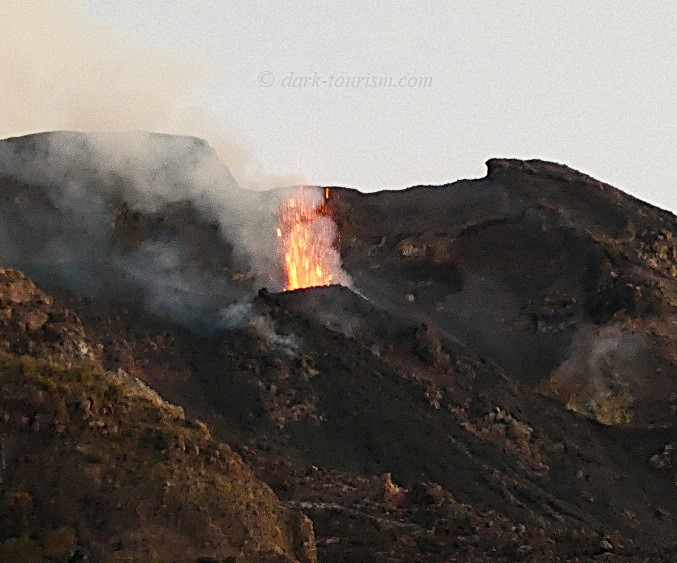
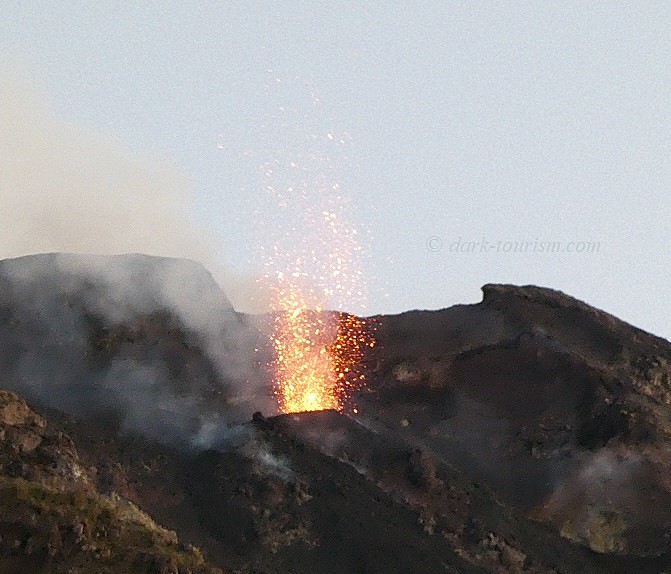
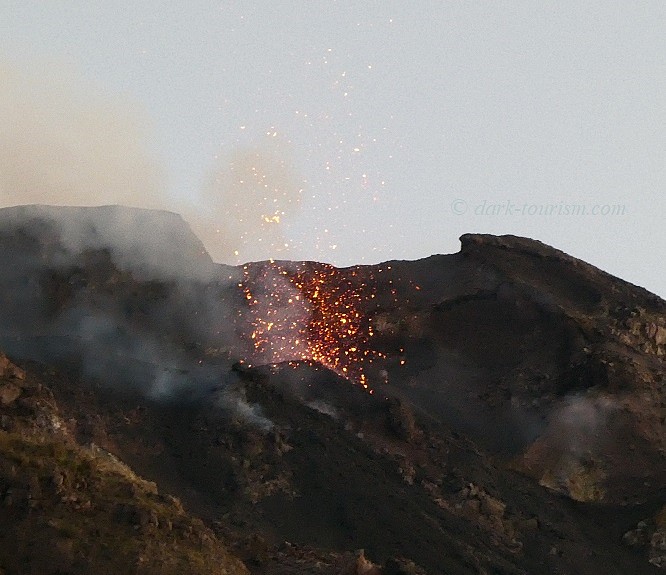
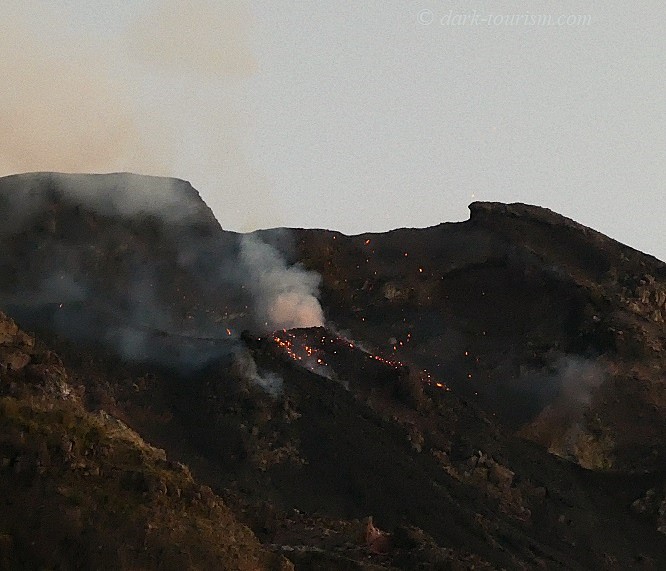
.
Most of the action came from the crater right at the edge of the top of the Sciara del Fuoco slope (luckily for us, because the crater furthest away from it would have hardly been visible). At a couple of points the second crater just behind the one at the front also erupted, as seen in the next image:
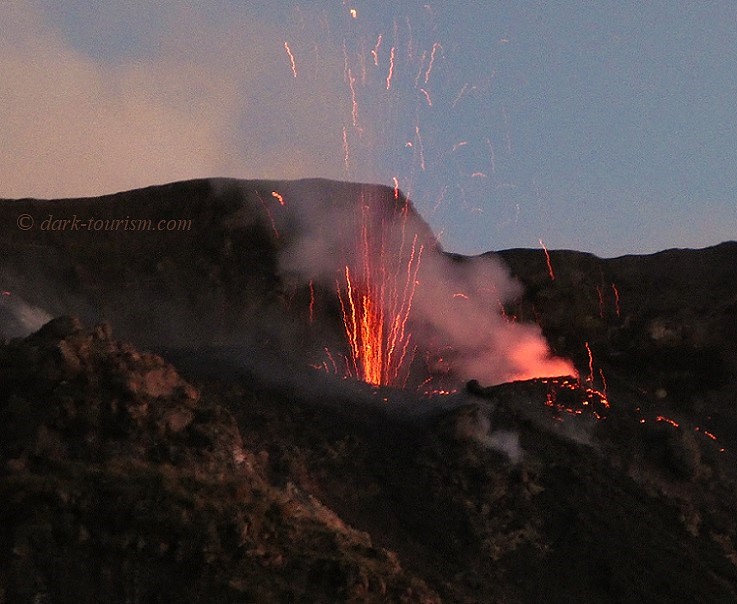
.
And at one point both craters erupted at the same time:
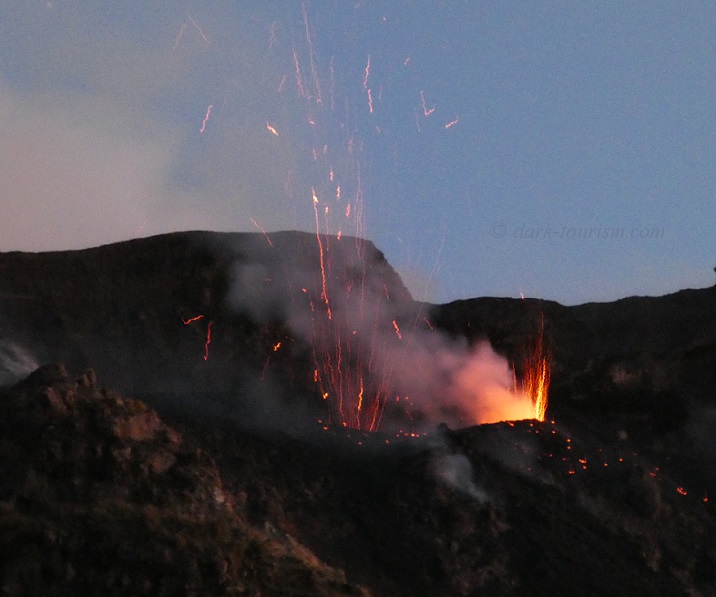
.
This was followed instantly by one of the biggest bursts from the front crater that evening, again captured through 4k-video photo extraction afterwards:
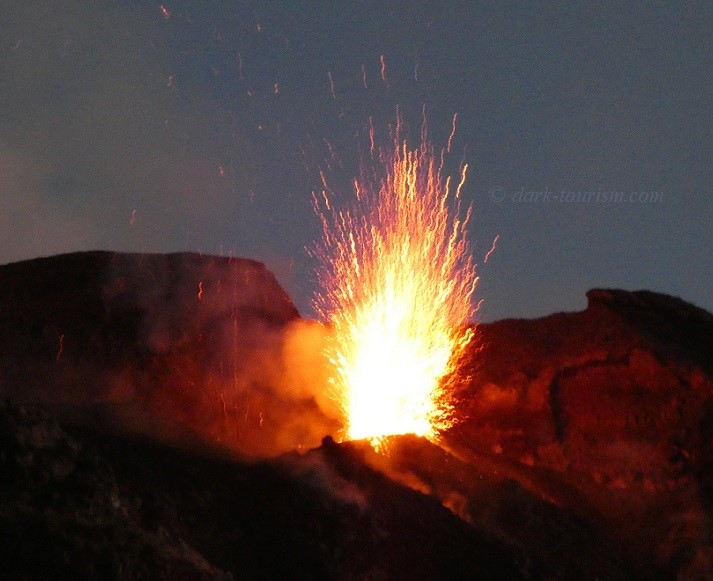
.
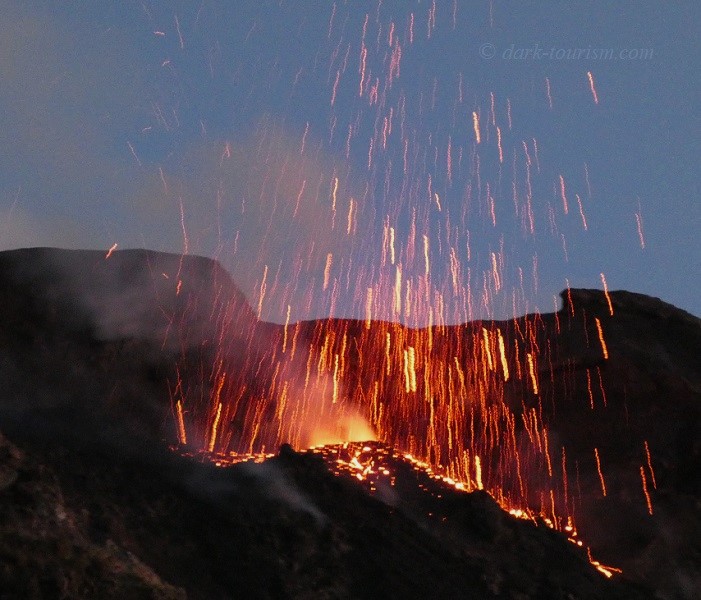
The ejected red-hot material then gets pulled back down by gravity (same photo as the featured one at the top of this post):
.
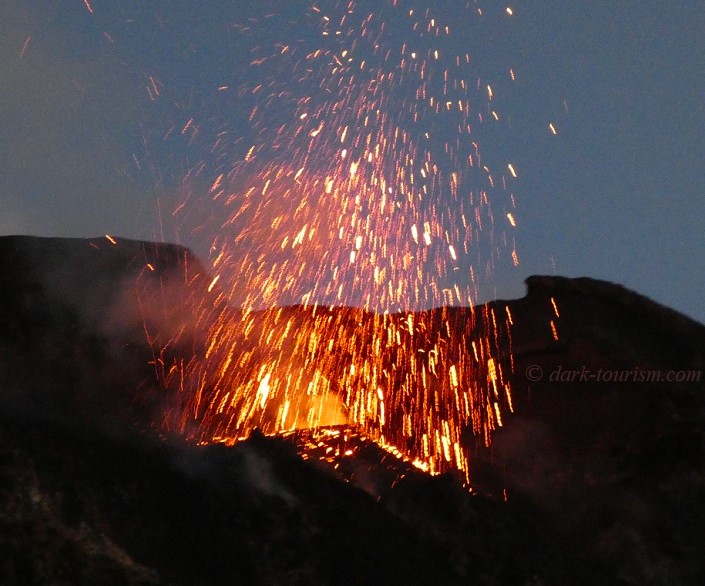
.
This looks like it’s “raining” fire – and the rim of the crater gets strewn with red-hot blocks of lava, some of which then start their journey down the Sciara del Fuoco while losing their glow as they cool:
.
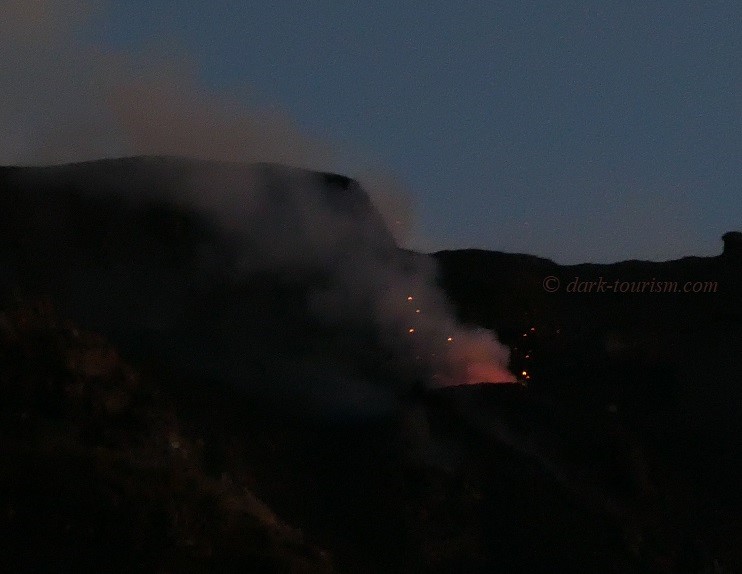
We witnessed several big ejection bursts. That evening they occurred roughly every five to ten minutes, so we got to see quite a few of them during the one hour we were given at the viewpoint (apparently that frequency is above average, so we were actually quite lucky). In between these bursts, the crater is constantly sputtering out smaller amounts of red-hot rocks (which you can only really see properly after dark):
.
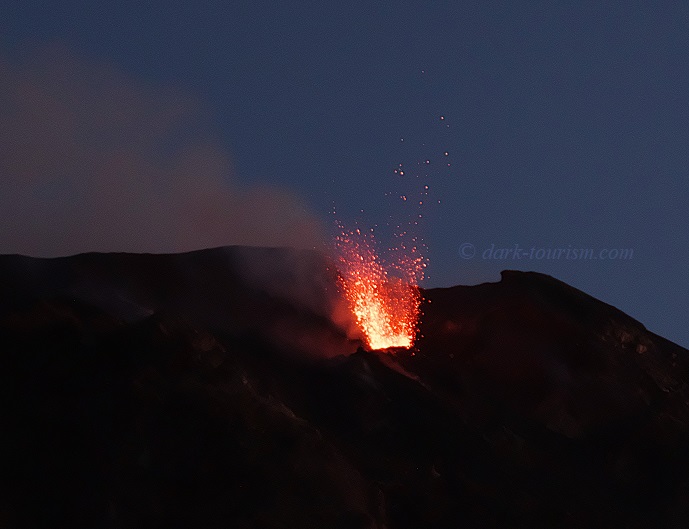
After nightfall, my superzoom camera increasingly had trouble finding the correct focus in still photos, and in videos it started to constantly go in and out of focus. So eventually I gave up on it (it had done its job well earlier anyway) and tried to capture a series of photos with my dSLR, even though that had only a 7x zoom reach. Most of the photos didn’t work out, but I got a couple of lucky shots in, and here’s a somewhat cropped one of those:
.
If the image looks familiar, then you will have seen it in the previous Blog post, where it served as the single taster photo of Stromboli.
Eventually our group was summoned back together for the beginning of the descent from the mountain. The first steep part was difficult but then we took a route different to the one we had taken to get here and this alternative route for the return hike proved much easier, as it basically just zig-zagged down without much climbing being necessary. This is also the route you can take without a guide to the second viewpoint at 290m above sea level (where we saw a lone photographer with a tripod and long lens pointing at Stromboli’s action).
After another two hours or so we were back in the village, returned the hard hats and walking sticks and our group and guide parted. We were back at our hotel and in bed before midnight and I slept like a log.
The next day we abandoned the idea of hiking the route to the 290m viewpoint without a guide as we reckoned that the previous night’s show could hardly be topped and we’d be so much further away from the action there. So instead we made the day a proper holiday, relaxing, mooching around the village and the waterfront, having some drinks while enjoying a sea view and just taking things slow and leisurely.
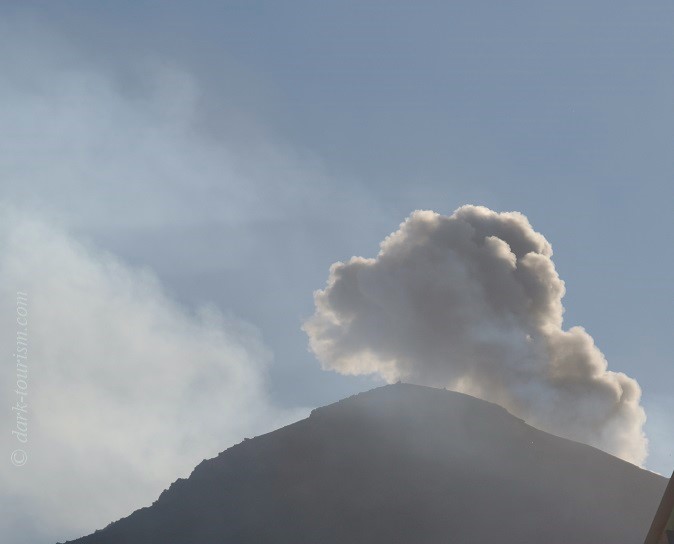
Yet the volcano makes its presence known every so often even down by the village. Occasionally you hear more than just the normal roar of the Strombolian eruptions (invisible from the village) and instead a loud deep thundering noise. These somewhat disturbing sounds are the result of bigger explosions and some of these leave plumes of smoke as daytime visual evidence too:
.
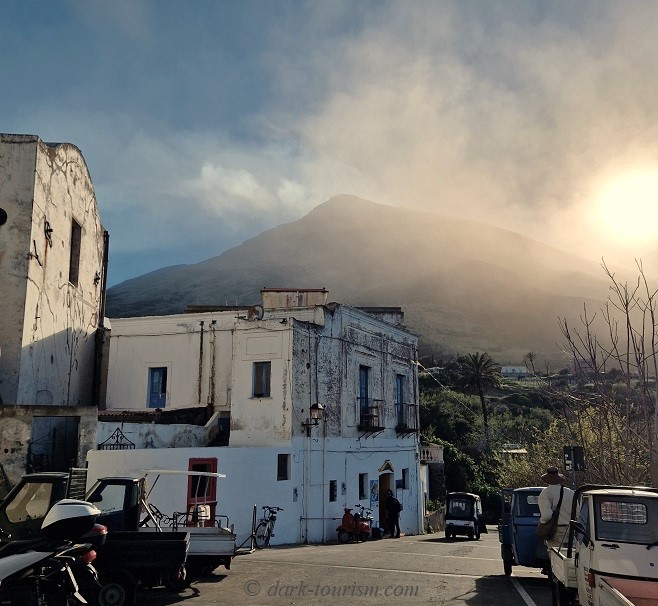
Most of the time the plumes of smoke drift sideways off the island, but on one occasion the smoke descended down the slopes towards the village, fortunately not quite reaching street level before dispersing:
.
I remembered from Indonesia, especially Ijen, how aggressive sulphurous gases can be for the nose and eyes, and wasn’t keen on another encounter with that without having a mask or respirator.
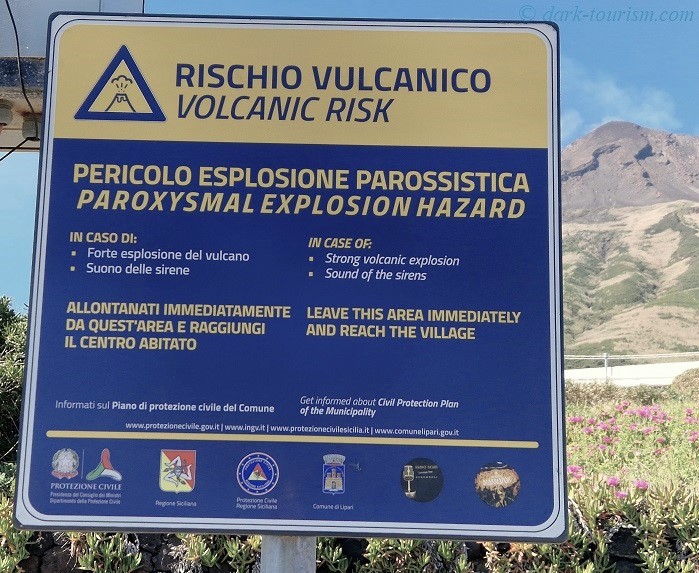
The fact that the volcano is at times an unruly neighbour can also be seen from the many warning signs dotted around the village and hiking paths. One type warns of paroxysmal explosions:
.
Paroxysmal eruptions are sudden heavy bursts ejecting material much higher than normal (not like what we had seen the previous night), sometimes together with lava fountains. Such paroxysmal eruptions are usually short-lived, though. But it’s those that can pose a danger even to the inhabited parts of Stromboli (while the larger crater rim around the side of the summit craters shields the village completely from the continual normal eruptions).
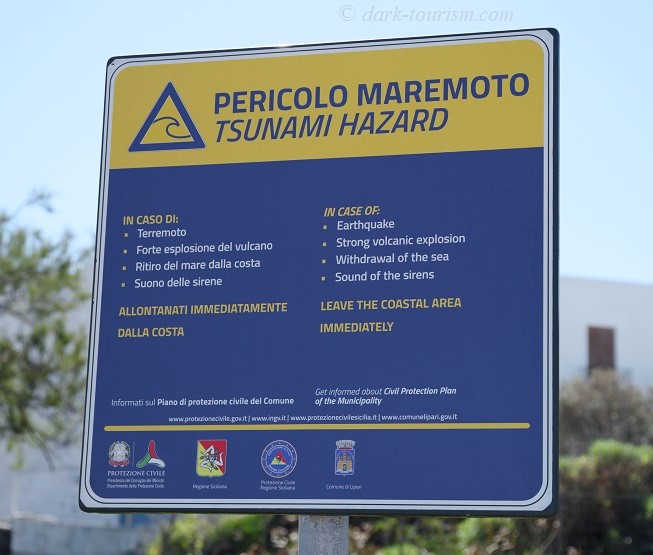
Another danger posed by the volcano are tsunamis, such as happened in 2002 when a large landslide off Sciara del Fuoco created a tidal wave up to ten metres high! Here’s one of the tsunami warning signs:
.
Escape routes towards higher ground are also signposted to augment the general warning signs. (By the way, our hotel room was, I reckon, about ten metres above the sea …)
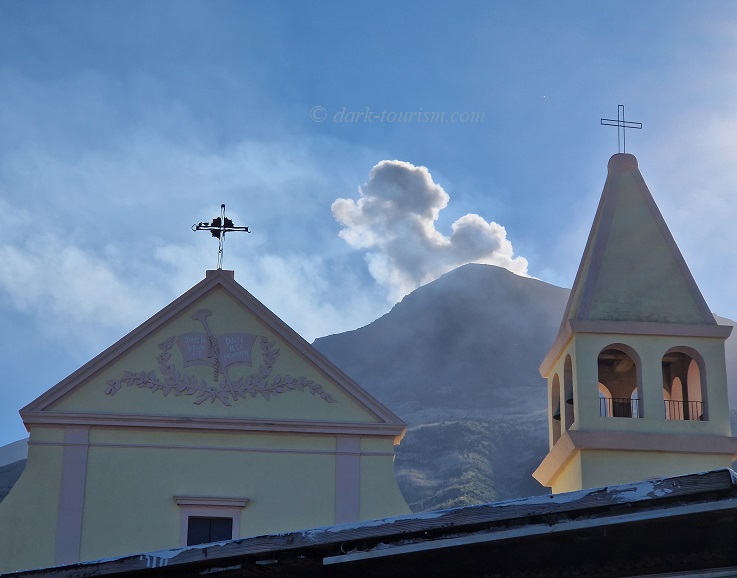
There were no tsunamis or paroxysmal eruptions while we were there, but plumes of smoke from bigger explosions were emitted several times.
.
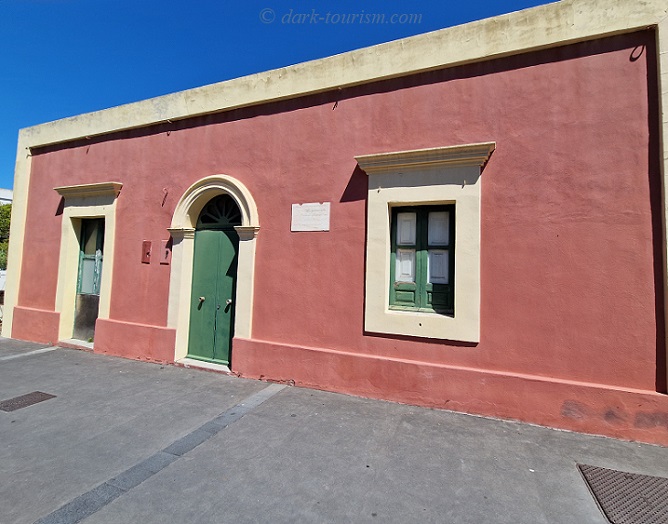
Stromboli is known not only for its volcanic action. In 1949/50 Italian director Roberto Rossellini filmed a movie here, entitled “Stromboli” and starring Swedish film celebrity Ingrid Bergman (in fact the film project goes back to her initiative initially). During the production of the movie, Bergman and Rossellini had a steamy extramarital affair and lived together in this ochre-red house on Stromboli:
.
Their affair was quite a scandal at the time, not just in Catholic Italy, but also in the conservative USA of the 1950s, where there were calls for banning the movie and Bergman’s Hollywood career stalled for a while. The child “out of wedlock” that came out of the affair in 1950 was followed by the couple getting married and having two more children (twins) in 1952, one of whom is Isabella Rossellini who went on to become a celebrated actress herself.
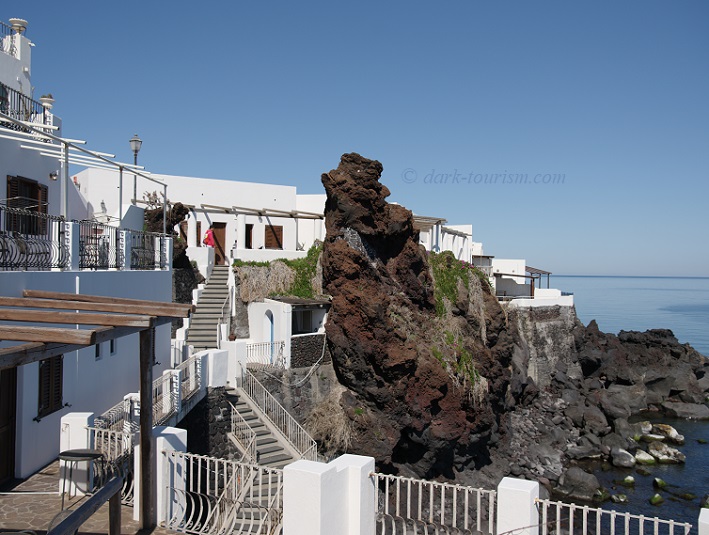
The Hotel Villaggio Stromboli, where I spent my two nights on the island, featured in its public areas scores of framed black-and-white photos from the “Strombili” movie and its production, including several of Bergman and Rossellini (none of which, obviously enough, I could reproduce publicly here for copyright reasons).
.
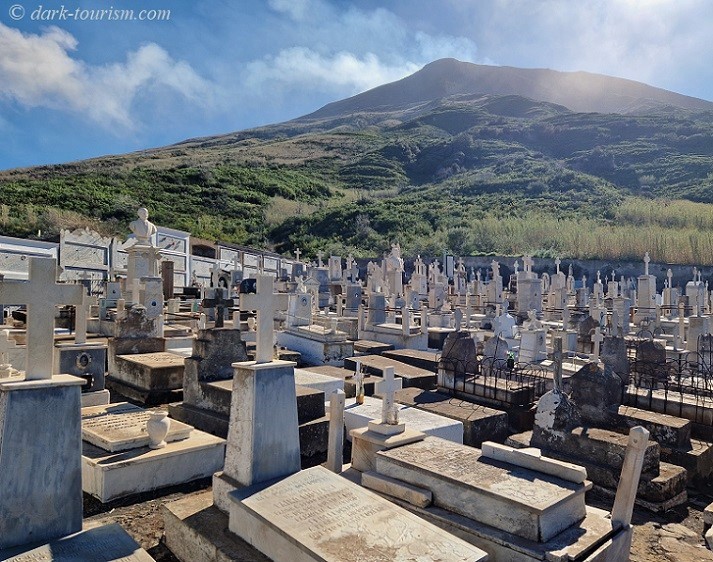
There’s one more minor attraction for dark tourists on Stromboli – its cemetery … with a view of the volcano!
.
The cemetery had several interesting tombstones and inscriptions. In particular I remember one grave for a guy from Berlin who went on to reside in Paris, Algeria, Antarctica (!!), Valparaiso in Chile, Banska Bystrica in Slovakia and ended up living out his days on Stromboli!
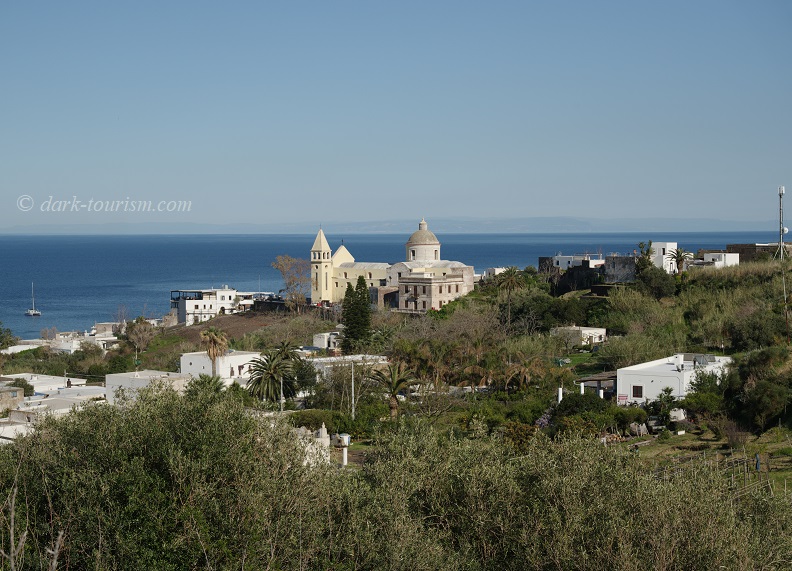
In addition to interesting graves, the location of the cemetery high above the village also afforded good views down to the sea and the village with its prominent church:
.
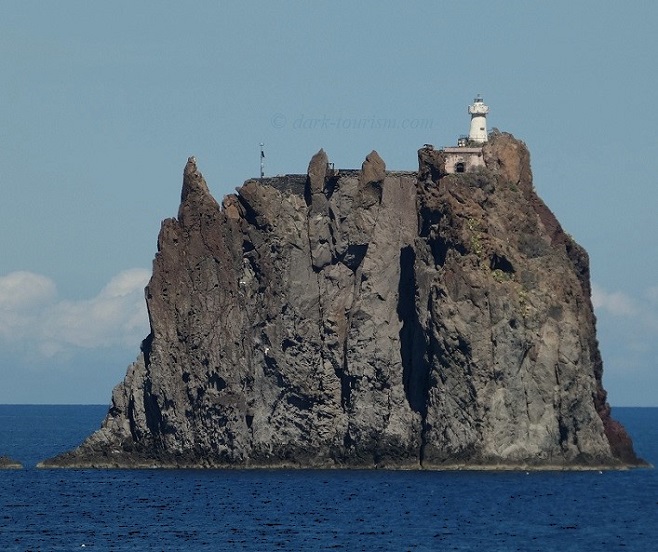
Not visible in this frame (it would have been to the left of it), but featured in the final photo of this post is Strombolicchio (meaning ‘Little Stromboli’):
.
This is a basalt sea stack that is the remnant of a previous volcano, its ‘volcanic plug’ to be precise, from which the island of Stromboli originally grew some 200 millennia ago until the crater moved to its present location. The stack consists of extremely hard basalt rock and hence resisted erosion, while everything around it has long been carried away by the sea and wind. What you see above the waterline is only the tip of a basalt column that our Stromboli hike guide claimed was over a hundred metres tall underneath the waterline and hence a dizzying, vertigo-inducing view for anyone daring to go diving there. Access to Strombolicchio is extremely restricted, though, because it is home to some rare and endangered species. Yet there is a small lighthouse on it …
But with this I shall come to the close of this rather long post with over 30 photos (well above average for this Blog). I hope you enjoyed reading it – and, of course, seeing the photos of the Strombolian volcanic action!
.
.